
 Volkswagen
 BMW
BMW MINI
MINI Mercedes
 Ford
Ford Peugeot
 Citroën
 Opel
OpelThe camshaft's role in engine performance
Duration, lift and lobe separation - understand how the camshaft's profile shapes power, torque and drivability. The basics of cam profiles explained. A guide from Meksta.
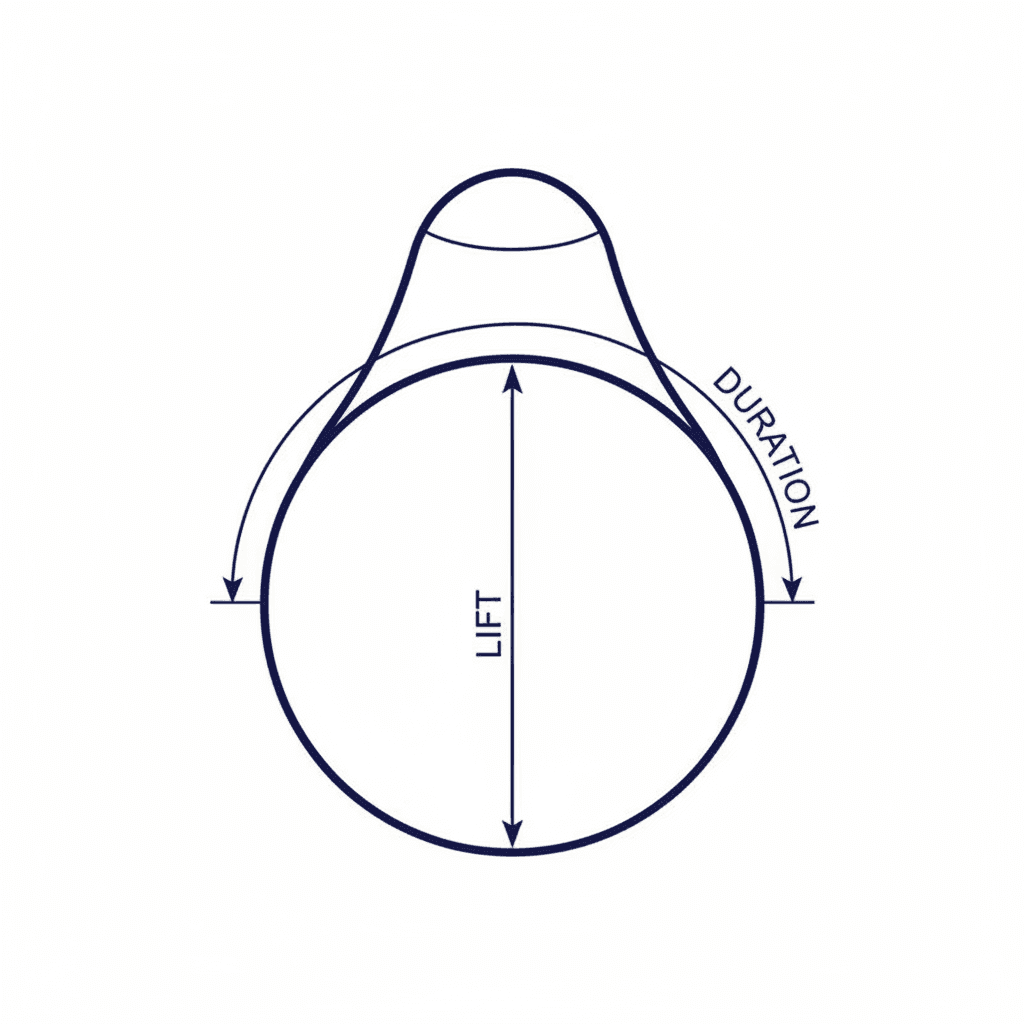
The camshaft controls the opening and closing of the intake and exhaust valves through its lobes. As the camshaft rotates, the lobes push against the valves and determine how much air and fuel enters, and how efficiently the exhaust gases leave the cylinder. Without a correctly designed camshaft, the engine can never reach its full potential.
The camshaft's basic characteristics
Duration
Duration is measured in degrees of crank angle and indicates how long the valve is held open. Longer duration gives the valve more time to breathe, which benefits power at high RPM - but at the cost of idle quality and midrange.
Shorter duration prioritises strong midrange, smooth idle and good throttle response - ideal for street cars and engines that need to be drivable day to day.
Lift
Lift indicates how far the valve opens, measured from the closed position to the maximum open position. Higher lift gives a larger opening area and therefore better flow at any given moment. But higher lift also places greater demands on valve springs, lifters and valve guides.
Lobe separation
The cam angle - often called lobe separation or LSA - is the angle, in cam degrees, between the centrelines of the intake and exhaust lobes. A tighter LSA gives more overlap (the period when both valves are open at the same time), which can improve power at high RPM but worsen idle quality and low RPM torque.
A wider LSA gives a smoother idle, better vacuum at low revs and more civilised drivability.
How the design affects performance
Aggressive cam profiles with high lift and long duration maximise airflow - perfect for engines where top end power matters most. These profiles pull well high up in the rev range but can be difficult to live with in everyday driving.
Milder profiles prioritise torque at low and midrange revs, smooth throttle response and good drivability. They are often the right choice for street cars and everyday driving.
Camshaft choice and emissions
Camshaft design also plays an important role in meeting emissions requirements and fuel efficiency. By carefully controlling valve timing and overlap, exhaust emissions can be minimised and fuel economy improved without sacrificing noticeable performance.
Adapting for different applications
The engine's specific characteristics - compression, cylinder head flow, exhaust system - determine which camshaft profile gives the best result. By optimising lift, duration and lobe separation, the engine's behaviour can be tailored for specific racing classes, street use or daily driving.
This process often requires dyno testing, real world driving and correctly degreeing the camshaft to validate the camshaft's performance across the whole rev range.
Summary
The camshaft is not a component you buy and fit without a second thought. Its profile, duration, lift and lobe separation define the engine's character - from how it behaves at idle to where the power peak sits. The right camshaft for the right application makes the difference between an engine that performs and one that disappoints.
Meksta has the experience to help you find the perfect camshaft profile for your build. Contact us and we will work out the right specification.
About the author
Robert Wiklund has worked with engines for over 30 years, including for Mazda Rally Team Europe, Toyota Team Europe and GM's rally programme. He founded Meksta in 2023.
Read more about Meksta →Does your engine need reconditioning or tuning?
Contact us for expert advice, whether it is a crankshaft, a turbo upgrade or cylinder boring.