
Crankshaft grinding & polishing
We grind, polish and balance crankshafts for all engine types, from four-cylinder car engines to V8, V12, marine and industrial engines. Mainly with our own machine shop and 30+ years of experience.
What is crankshaft grinding?
Crankshaft grinding means the main and rod bearing journals are ground to a controlled undersize, polished and checked for straightness. This restores the bearing clearance and gives the engine an even oil film and quiet running.
The backbone of the engine
Knocking from the engine? Low oil pressure? The crankshaft converts the up-and-down motion of the pistons into rotation. It is one of the most heavily loaded components in the engine and takes enormous forces on every combustion cycle. Even though crankshafts are made from high-strength steel or tough cast iron, the bearing journals wear over time, especially if oil changes are neglected or the engine is driven hard.
At Meksta we have experience reconditioning crankshafts from virtually every engine type. We grind, polish and balance, and we do it with the precision required to keep the crankshaft running for many thousands of miles more.
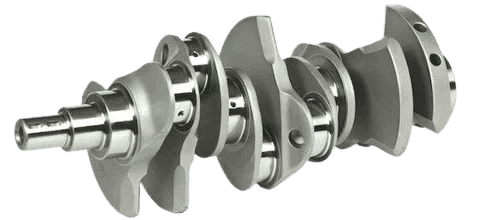
Precision grinding of bearing journals
When the bearing journals on the crankshaft are worn, scored or oval, they are ground down to the next undersize. The manufacturer usually specifies 2-3 undersize steps (for example -0.25, -0.50 and -0.75 mm). For each step there are matching undersize bearings available to buy.
The grinding is carried out on a dedicated crankshaft grinder, where the crankshaft is ground to exact undersize with a controlled surface finish. The result is a perfectly round, straight bearing journal with the correct finish for optimal oil retention.
We grind both main journals and rod journals. Every journal is measured before and after with a micrometer to guarantee the dimensions are within specification.
Polishing of bearing journals
Polishing is used when the bearing journals are within dimensional tolerance but have minor scratches, marks or surface imperfections. Polishing the journals with fine abrasive paper or a polishing belt improves the surface finish without changing the dimension appreciably.
Polishing is also common as a final step after grinding to achieve an even better surface finish. A well-polished bearing journal reduces friction and improves oil retention, which extends the life of both the bearings and the crankshaft.
Balancing alongside grinding
An unbalanced crankshaft creates vibrations that increase with rpm and wear on bearings and seals. We often balance the crankshaft together with grinding, especially on V8 engines and performance builds where the engine will be revved high. We describe the full process, the methods and the pricing on our page about crankshaft balancing.
Crack detection
Before grinding we always check the crankshaft for cracks. We use magnetic particle inspection (Magnaflux), where the crankshaft is magnetised and dusted with iron powder that collects in any cracks. Even microscopic cracks invisible to the naked eye are found this way.
A cracked crankshaft cannot be repaired and must be replaced. Finding a crack before assembly saves both time and money compared with a failure in service.
What does crankshaft grinding and balancing cost?
The prices below apply to typical 4-cylinder engines and are excluding VAT. V6 and V8 engines are quoted separately. You always get an exact quote after inspection.
| Service | Description | Price from (excl. VAT) |
|---|---|---|
| Crankshaft grinding | Grinding of main and rod bearing journals to undersize. | 1 470 kr |
| Crankshaft polishing | Polishing of bearing journals for improved surface finish and oil retention. | 1 022 kr |
| Dynamic balancing | Balancing the crankshaft, flywheel and clutch cover. | 3 742 kr |
| Crack detection (Magnaflux) | Magnetic particle inspection to detect hidden cracks. | 800 kr |
All prices excl. VAT. V6, V8 and larger engines cost more. See the full price list
Engine types we work with
We recondition crankshafts for all types of combustion engines:
- Cars (all makes, petrol and diesel)
- Motorcycle engines
- Marine engines (inboard and outboard)
- Industrial engines and generators
- Classic cars and vintage vehicles
- Race and performance engines
How we work - from inspection to finished result
From inspection to a fully balanced crankshaft. A proven process.
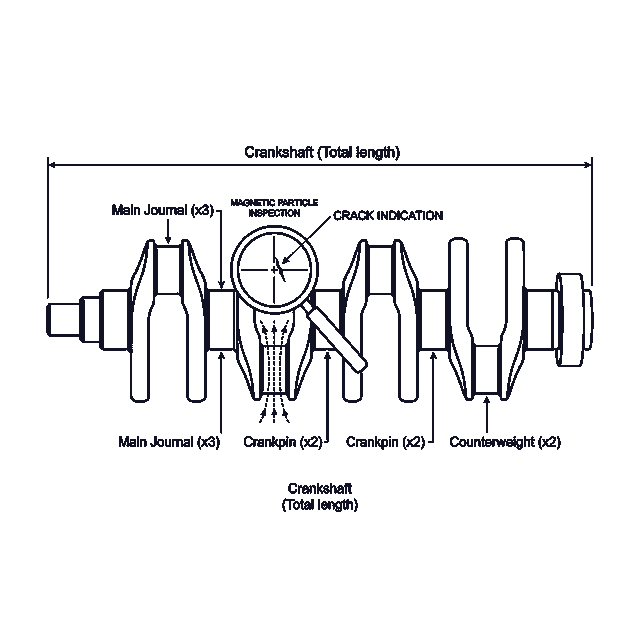
Crack detection
We measure the straightness of the shaft and look for fatigue cracks (Magnaflux/dye penetrant). This is to make sure the material is sound.
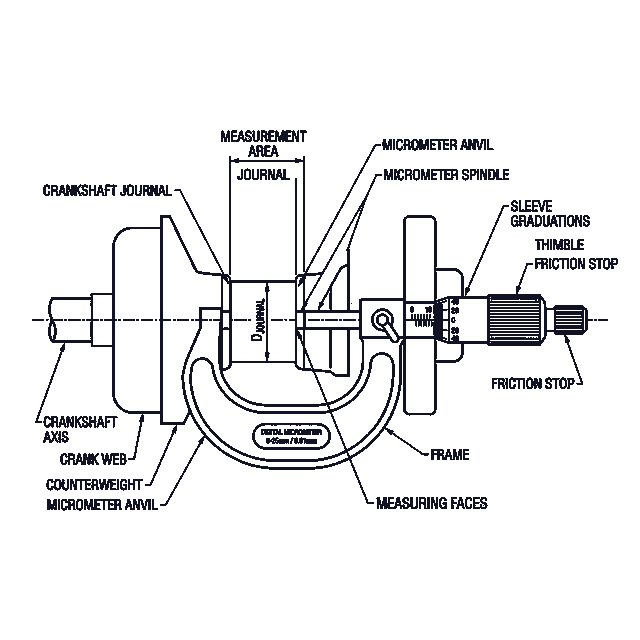
Measurement & straightening
Vevlager- och ramlagertappar mäts upp. Om axeln är böjd riktar vi den noggrant (rullriktning) före slipning, så att balansen inte påverkas i onödan.
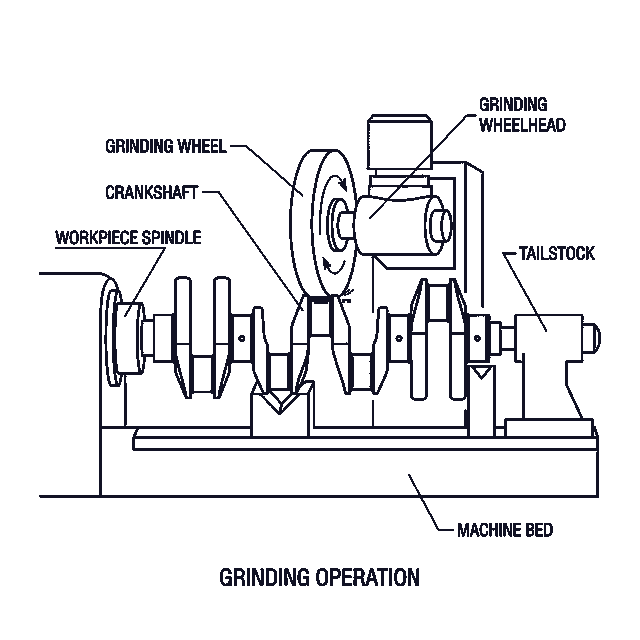
Precision grinding
Axeln monteras i vår vevaxelslipmaskin, centreras upp och tapparna slipas till nästa korrekta underdimension, normalt 0,25 eller 0,50 mm.
Micro-polishing, wash & balance
All journals are then carefully polished to a high shine. The shaft also usually undergoes dynamic balancing to suppress harmful rpm vibrations.
Crack detection
We measure the straightness of the shaft and look for fatigue cracks (Magnaflux/dye penetrant). This is to make sure the material is sound.
Measurement & straightening
Vevlager- och ramlagertappar mäts upp. Om axeln är böjd riktar vi den noggrant (rullriktning) före slipning, så att balansen inte påverkas i onödan.
Precision grinding
Axeln monteras i vår vevaxelslipmaskin, centreras upp och tapparna slipas till nästa korrekta underdimension, normalt 0,25 eller 0,50 mm.
Micro-polishing, wash & balance
All journals are then carefully polished to a high shine. The shaft also usually undergoes dynamic balancing to suppress harmful rpm vibrations.
Do the maths yourself
Use our free tools to run the numbers on your project before you get in touch.
Frequently asked questions about crankshaft reconditioning
Need a reconditioning job?
Send in your crankshaft for measurement and assessment, or drop it off at our workshop. We get back to you within 24 hours.
Common engines we recondition
See what a reconditioning means for your specific engine - prices, common faults and specifications per engine family.