
What is a crankshaft?
The crankshaft is the backbone of the engine. Learn how it works, why it wears and when it needs reconditioning.
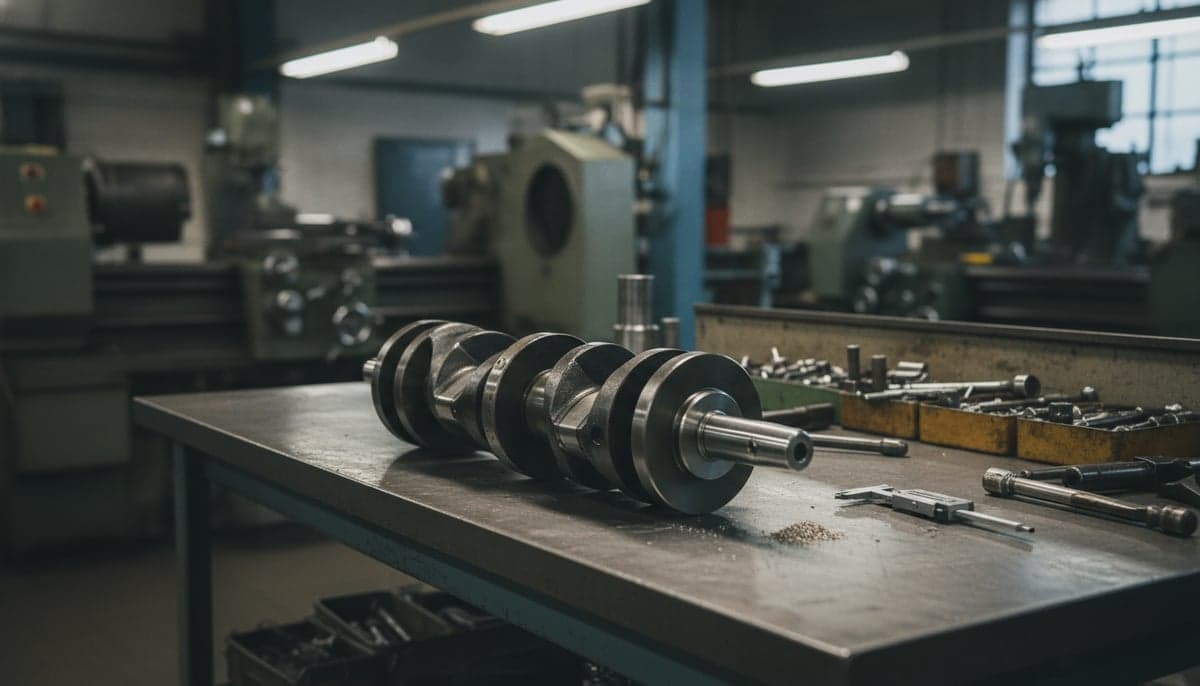
How does a crankshaft work?
A combustion engine produces power by igniting fuel in the cylinder. The explosion drives the piston downwards. The piston is attached to a connecting rod, which in turn is attached to the crankshaft. As the piston moves up and down, the connecting rod turns the crankshaft.
The result is a smooth, rotating motion that is transferred through the flywheel to the gearbox and on to the drive wheels. In a four-cylinder engine, four pistons work in a set firing order to deliver the smoothest possible rotation.
The crankshaft is supported in the engine block by main bearings, and each connecting rod has its own big-end bearing. These bearings are critical - they are exposed to enormous forces and must be lubricated continuously by the engine oil.
What is a crankshaft made of?
In most passenger cars the crankshaft is cast from special alloy iron or forged from steel. Forged crankshafts are stronger and are used in engines under higher loads, such as racing, turbocharged and diesel engines. Cast crankshafts are more than enough for everyday driving.
The bearing journals (the surfaces that ride against the bearings) are hardened and precision-ground to minimise friction. These surfaces must be polished to a mirror finish and held to exact dimensions for the bearings to work correctly.
Why does the crankshaft wear?
Even though the crankshaft is a robust component, it wears over time. The most common causes of crankshaft wear are:
Journal wear
The bearing journals wear gradually when oil changes are skipped. This gives increased play, noise and eventually sudden bearing failure.
Oil starvation
If oil pressure drops, the crankshaft bearings can overheat and seize. That quickly destroys both the bearings and the crankshaft.
Contaminated oil
Metal shavings, coolant or fuel in the oil act as an abrasive and wear down the journal surfaces prematurely.
High revs
Engines run hard in racing or with heavily raised boost pressure put the crankshaft under extreme physical load.
Signs that the crankshaft needs reconditioning
There are several symptoms that can indicate the crankshaft or its bearings are worn:
- Knocking or thumping noise from the lower part of the engine
- Low oil pressure (warning light on)
- Rough running or heavy vibrations
- Metal particles in the oil at an oil change
If you notice any of these, it is important to act quickly. A crankshaft that fails completely can cause secondary damage that is far more expensive to put right.
How is a crankshaft reconditioned?
In a crankshaft reconditioning the journals are ground down to the next undersize. This removes scoring, grooves and unevenness on the surface. The surfaces are then polished to a mirror finish to minimise friction.
New bearings in the correct undersize are fitted and the crankshaft is balanced if needed. Balancing is especially important at higher revs and on engine types with an uneven crank angle.
A properly reconditioned crankshaft can last as long as a new one, provided the rest of the engine is also in good condition and oil changes are kept up regularly.
Read more about crankshaft reconditioning at Meksta →
Read about dynamic crankshaft balancing →
Recondition instead of replacing
A new crankshaft often costs tens of thousands of kronor. Reconditioning your existing crankshaft costs a fraction of that and delivers the same result in terms of dimensions, surface finish and service life. It is also the more environmentally friendly choice.
Robert has over 30 years of experience in crankshaft grinding and rebuilding. We measure, grind, polish and balance to OEM specification.
About the author
Robert Wiklund has worked with engines for over 30 years, including for Mazda Rally Team Europe, Toyota Team Europe and GM's rally programme. He founded Meksta in 2023.
Read more about Meksta →Does your engine need reconditioning or tuning?
Contact us for expert advice, whether it is a crankshaft, a turbo upgrade or cylinder boring.