
Free tools
Carburettor size
Too large a carburettor gives poor throttle response, too small a one chokes the top end. Enter the displacement, the maximum rpm and the type of setup you have, and you get the air demand and a suitable carburettor size.
All tools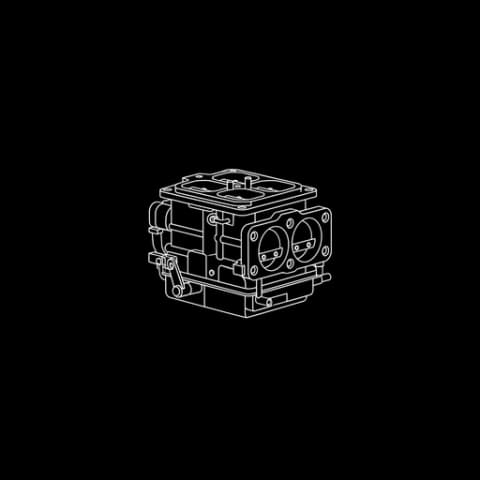
Required air demand(Example values)
531 CFM
Recommendation: one carburettor of 600 CFM.
How the calculation works
The classic carburettor formula takes the displacement in cubic inches times the rpm, divided by 3456. The number 3456 comes from a four-stroke filling its volume once every two revolutions. We convert your volume from litres to cubic inches for you (1 litre is about 61 cubic inches).
The volumetric factor adjusts the result to how well the engine breathes. A mild street engine sits around 0,88, while a tunnel ram and race setup go over 1,0 to give a margin for ram filling. With two carburettors the demand is split, and the result gives a recommended size per carburettor.
Example
A 5,7-litre V8 (350 CID) revving to 6000 with a mild street setup needs around 530 CFM, which points to a 600 CFM carburettor.
Setup and volumetric factor
| Setup | Volumetric factor |
|---|---|
| Mild street | 0,88 |
| Street and strip | 1,03 |
| Race, high single | 1,16 |
| Pro series 4500 | 1,22 |
| Tunnel ram, cast | 1,50 |
| Tunnel ram, race-ported | 1,80 |
| Sheet-metal intake race | 1,92 |
| Pro Stock | 2,10 |
More tools
Common questions about carburettor size
Need help with your engine build?
Describe your project and we will get back to you within 24 hours. Quote after inspection.