
 Volkswagen
 BMW
BMW MINI
MINI Mercedes
 Ford
Ford Peugeot
 Citroën
 Opel
OpelOverlap: when both valves are open
What is overlap and why does it affect idle, vacuum and performance? Here's how valve overlap works - and why turbo and naturally aspirated engines need different amounts.
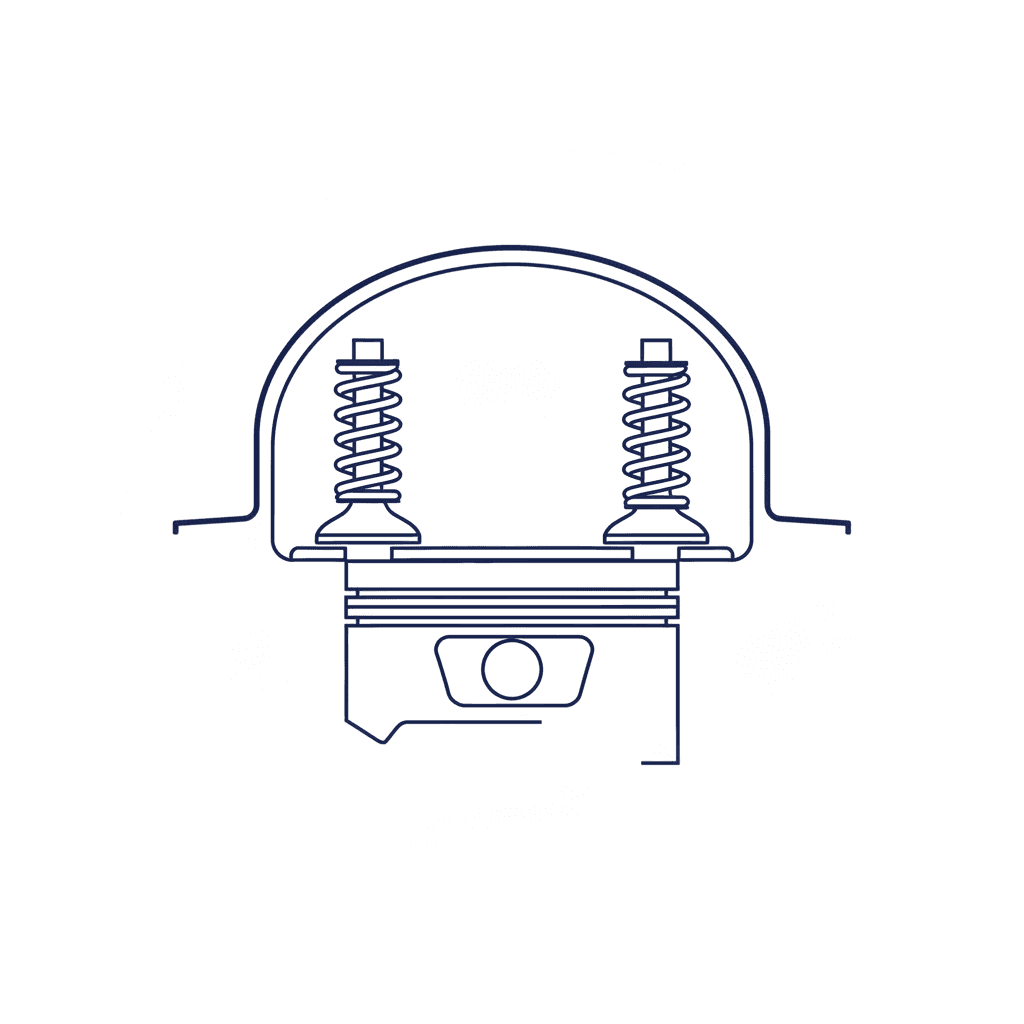
Overlap, or valve overlap, is the period when both the intake and exhaust valves are open at the same time. It happens around top dead centre, right in the transition between the exhaust stroke and the intake stroke. ENEM, one of Sweden's most established camshaft manufacturers, describes it like this: "Overlap is the point where the exhaust valve is closing and the intake valve has started to open. Both valves are open at the same time, and the piston is essentially at its highest point."
What determines the amount of overlap?
Overlap is not a single, standalone property of the camshaft - it is the result of duration and lobe separation working together.
- Longer duration - the longer the valves are held open, the more of that window overlaps around TDC.
- Tighter lobe separation - the closer the intake and exhaust lobe centrelines are to each other, the more overlap.
COMP Cams' lobe designer Billy Godbold demonstrates this with numbers: three camshafts with an identical 110° lobe separation angle but different durations gave widely different overlap - from 53° with shorter duration to 77° with longer. Lobe separation angle alone doesn't determine how much overlap you get.
Why overlap exists
In a naturally aspirated engine, overlap creates a scavenging effect. The momentum of the exhaust gases creates a low pressure zone behind them - that effect helps draw in fresh charge through the intake port even before the piston has started its downward stroke. At high RPM, this exhaust scavenging can noticeably improve cylinder filling and, with it, power.
Racing cams for naturally aspirated engines therefore often have a tight lobe separation (104-108°) and long duration that produces large overlap. That maximises top end power but costs idle quality and low RPM torque.
Overlap and idle
At low RPM and small throttle openings, overlap creates problems. Residual exhaust gas in the combustion chamber gets pushed back out into the intake system - what is known as reversion. The more overlap, the more reversion:
- Intake pressure rises (vacuum drops)
- The fresh mixture is diluted with inert exhaust residue
- Idle becomes rough and uneven
- Fuel consumption and emissions increase
Tests on the same engine with three different lobe separations (106°, 112° and 114°) at identical duration showed that 112° gave the best compromise: smooth idle, 2 inches more vacuum than the 106°, four miles per gallon better fuel economy - and essentially the same power up to 4,000-4,500 rpm. Only after that point did the tighter lobe separation pull ahead.
Overlap in turbo engines
In a turbo engine, the rules of the game change. The turbo creates positive pressure in the intake (boost) and, at the same time, backpressure in the exhaust system. The relationship between these two pressures determines what happens during overlap:
- If exhaust backpressure is higher than boost - exhaust gas gets pushed back into the cylinder and out into the intake system. It acts like internal EGR at full throttle and costs power.
- If boost is higher - fresh charge air blows straight through the cylinder and out into the exhaust system. That wastes boost and can overheat the exhaust valves and turbine.
ENEM states: "Forced induction engines, almost without exception, produce more power with a wide lobe separation" - in other words, a wider lobe separation with less overlap. That is why turbo cams are traditionally designed with a 112-114° lobe separation, compared to 106-110° for naturally aspirated engines.
PF Racing, who design turbo cams specifically for the Volvo B230, consistently use what they call "dual lobe design" - different duration on intake and exhaust. A shorter exhaust duration closes the exhaust valve earlier and reduces the overlap window, without sacrificing intake duration. The result is quicker spool and cleaner cylinder filling under boost.
Modern turbos add nuance to the picture
Turbo technology has advanced significantly. Modern, efficient turbos have lower exhaust backpressure relative to boost compared with older designs. Bonneville record holder Kenny Duttweiler has shown that with a correctly sized modern turbo, you can run a tighter lobe separation (109°) and still keep a smooth idle with 16 inches of vacuum - something that was unthinkable with older turbo designs.
This does not mean you should run a tight lobe separation on just any turbo engine. But it does show that what matters most is not whether the engine is turbocharged, but how efficient the turbo is and how well the exhaust side flows.
Summary
Overlap is a result of duration and lobe separation, and it affects everything: idle, vacuum, midrange, top end power and exhaust emissions. There is no universal rule - the right amount of overlap depends on whether the engine is naturally aspirated or turbocharged, which RPM range matters most, and how efficiently the exhaust system flows.
Want to understand how your camshaft's overlap affects your engine? Contact Meksta - we will help you find the right balance.
About the author
Robert Wiklund has worked with engines for over 30 years, including for Mazda Rally Team Europe, Toyota Team Europe and GM's rally programme. He founded Meksta in 2023.
Read more about Meksta →Does your engine need reconditioning or tuning?
Contact us for expert advice, whether it is a crankshaft, a turbo upgrade or cylinder boring.