
 Volkswagen
 BMW
BMW MINI
MINI Mercedes
 Ford
Ford Peugeot
 Citroën
 Opel
OpelCompression and camshaft choice
Static vs dynamic compression, how duration lowers DCR, and why a bigger cam needs more compression. A matching guide from Meksta.
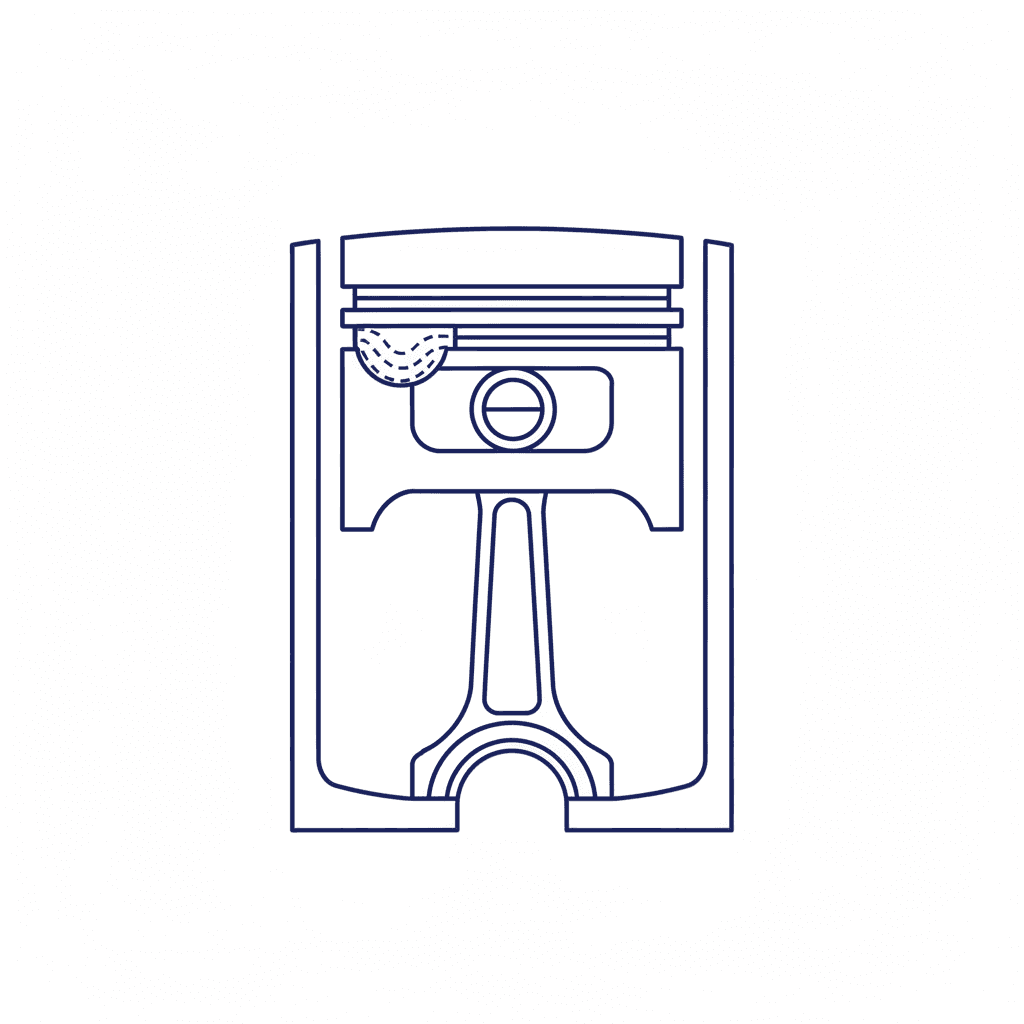
Compression and camshaft choice are more tightly linked than most people think. A bigger cam lowers the effective compression - and if you do not compensate, you can end up with an engine that has lower cylinder pressure than the original, despite a "sharper" profile.
Static vs dynamic compression
Static compression (SCR) is the geometric ratio between the cylinder's total volume and the combustion chamber volume - the figure you work out from the stroke, bore and clearance volume. It is the number that appears on the spec sheet: 10.5:1, for example.
Dynamic compression (DCR) is the actual pressure ratio, based on when the intake valve actually closes. And this is where the camshaft comes in.
A camshaft with a long duration holds the intake valve open longer after the piston has started its compression stroke. During that time, some of the intake charge gets pushed back out through the still-open valve. The actual compression only begins once the intake valve closes.
Hughes Engines, which specialises in Mopar performance, shows that an engine with 10.5:1 static compression and a mild cam (214° duration at 0.050″) can have an 8.4:1 DCR, while the same engine with a bigger cam (240° at 0.050″) drops to 7.4:1 DCR. Same block, same head, same pistons - completely different cylinder pressure.
Why DCR matters
It is DCR - not SCR - that determines:
- Detonation tendency - too high a DCR combined with low-octane fuel causes knock. Rule of thumb: 8.0:1 DCR for a cast iron head and 8.5:1 for an aluminium head on 95 octane petrol. E85 tolerates higher.
- Startability - DCR below 7.5:1 gives weak cranking compression and poor cold starting.
- Low rpm behaviour - low DCR means the engine does not build enough pressure at the bottom of the rev range. Idle becomes weak and throttle response gets sluggish.
Why a bigger cam needs more static compression
The logic is simple: if the camshaft lowers DCR through late intake valve closing, you need to compensate by raising the static compression. Otherwise you lose cylinder pressure, and with it torque, in the low rpm range.
That is why racing engines often run 12:1 or 13:1 static compression with big cams. The high static compression compensates for the late intake valve closing - DCR still ends up in a manageable range with the right fuel.
Conversely - if you fit a bigger cam in an engine with a standard 9.5:1 compression - DCR drops so low that the engine loses torque and feels "flat" below 3,000 rpm. That is the most common mistake when changing cams on street cars.
Rules of thumb for matching
Here are general guidelines used by engine builders and camshaft manufacturers:
- Mild cam (under 220° at 0.050″) - standard compression (9.5-10:1) works well. DCR lands around 8.0-8.5:1.
- Medium cam (220-235° at 0.050″) - 10:1 to 10.5:1 compression should be the target. Check the DCR.
- Big cam (235°+ at 0.050″) - 11:1 and up is often needed to keep a reasonable DCR. Your fuel choice (E85, racing) affects how high you can go.
These figures apply to naturally aspirated engines. In a turbo engine, lower static compression is used to leave room for boost, but the same principle applies: the camshaft's duration affects how much of that compression actually comes into play.
How to work out your DCR
You need:
- Displacement per cylinder
- Combustion chamber volume (measured or from spec)
- Piston-to-deck distance and any piston dome or dish value
- Cylinder head gasket compressed thickness and bore
- The intake valve's closing point (IVC) in crank degrees after BDC
You will find the IVC in the camshaft manufacturer's specification - it is the intake valve closing point measured at a specific lift (usually at 0.050″ or 1 mm). The formula takes into account how much of the displacement is actually compressed after the valve has closed.
There are online calculators that do the job once you enter the values. What matters is that you actually run the calculation - guessing at compression without knowing the DCR has caused more failed builds than bad cams.
Compression, cam and overlap
Compression's effect does not stop at DCR. High compression combined with a lot of overlap can cause problems: during the overlap period both valves are open, and if cylinder pressure is high, exhaust gases can get pushed back into the intake. That is another reason why aggressive cams with high compression often need precise degreeing to optimise the timing events.
Summary
Camshaft choice and compression ratio are not separate decisions - they are a package deal. Long duration lowers DCR, which requires higher static compression to compensate. Always check the DCR before you settle on a camshaft and pistons - that is the number that decides whether the engine works in reality, not just on paper.
Contact Meksta - we will help you match compression and cam profile.
About the author
Robert Wiklund has worked with engines for over 30 years, including for Mazda Rally Team Europe, Toyota Team Europe and GM's rally programme. He founded Meksta in 2023.
Read more about Meksta →Does your engine need reconditioning or tuning?
Contact us for expert advice, whether it is a crankshaft, a turbo upgrade or cylinder boring.