
 Volkswagen
 BMW
BMW MINI
MINI Mercedes
 Ford
Ford Peugeot
 Citroën
 Opel
OpelValve springs: how to choose the right spring
Seat pressure, open pressure, installed height and coil bind - everything you need to know to match valve springs to your camshaft. A guide from Meksta.
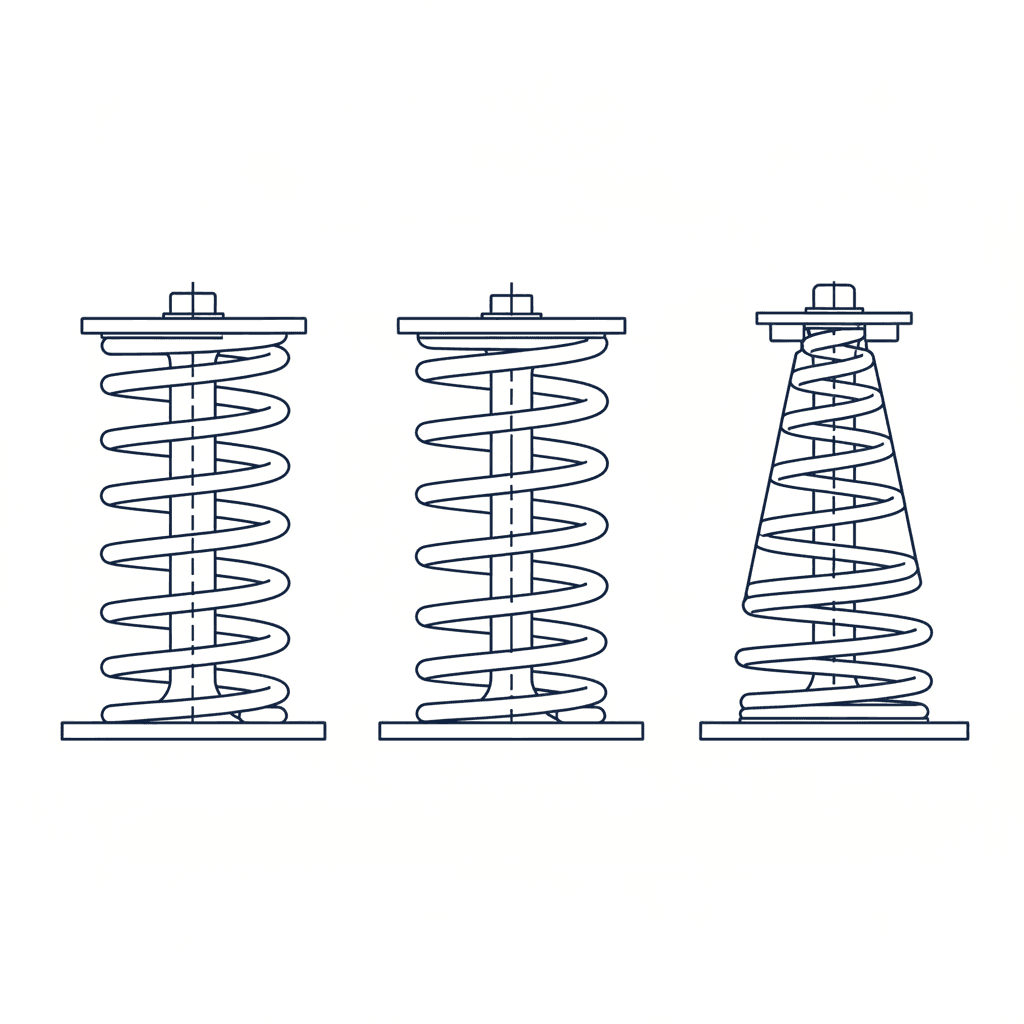
Valve springs do one job: they close the valve and hold it shut. But as cam profiles get more aggressive and RPM climbs, the demands increase dramatically. The wrong spring can cause valve float, spring surge, bent valves or premature wear on the cam and lifters. The right spring, on the other hand, protects the whole valve train and lets the cam profile do its job to the full.
Why the spring choice matters
The camshaft pushes the valve open, the spring pushes it back. As long as the spring can keep up with the cam profile, the valve closes correctly on every cycle. But if the spring is too weak, or cannot follow the cam's ramp speed, the lifter loses contact with the cam. This is called valve float, and it quickly damages the lifter and camshaft, and potentially causes valve-to-piston contact.
A spring that is too strong, on the other hand, increases friction and wear on the cam lobe, especially on flat tappet cams where the contact surface is already under stress. Kelford Cams recommends that flat tappet cams should never be run with a higher open pressure than the manufacturer specifies, precisely to protect the cam lobe surface.
Seat pressure and open pressure
Spring pressure is measured at two points: at installed height (seat pressure) and at maximum lift (open pressure).
- Seat pressure - the spring's force when the valve is closed. Enough pressure is needed to keep the valve sealed against the seat and stop it from bouncing on closing. Seat pressure for a mild street engine is typically 40-60 kg, while racing applications can call for 70-90 kg or more.
- Open pressure - the spring's force at maximum valve lift. This is the force that counters the cam's ramp speed. The more aggressive the cam profile and the higher the lift, the more open pressure is needed for the lifter to follow the cam all the way.
PF Racing, for example, states that their mildest turbo cams (PF-1T, PF-2T) run with the original Volvo springs, while the PF-3T and above require reinforced single springs, precisely because lift climbs to 13 mm and up, which places higher demands on open pressure.
Installed height
The spring's installed height determines seat pressure at assembly. If the cylinder head is resurfaced, the valves sit deeper, the spring compresses more and seat pressure increases. The height also changes if you switch to valves of a different length or different retainers.
Always check installed height against the spring manufacturer's specification. Valve spring shims (thin washers) can be used to adjust the height if it is off.
Spring types
Single spring
The most common type. A single cylindrical spring per valve. Suits most street engines and mild sport builds. The standard springs on most engines are single springs.
Dual springs
An inner and an outer spring working together. Gives higher total spring pressure and better control of resonance. Used in more demanding applications and racing. When breaking in flat tappet camshafts, the inner spring can be removed temporarily to reduce the load during the critical first 20 minutes.
Beehive springs
Conical shape, wider at the bottom, narrower at the top. The reduced mass at the top lets the spring follow more aggressive cam profiles at high RPM without surging. Beehive springs are often used as a modern upgrade that gives better performance than conventional cylindrical springs without unnecessarily increasing seat pressure.
Coil bind - a critical limit
Coil bind happens when the spring is compressed so far that the coils meet each other and the spring goes solid. If that happens at maximum valve lift, the result can be a bent valve, a broken spring or a damaged camshaft.
There should always be a margin between maximum lift and coil bind, usually at least 1.5 mm of spring travel left. Check this by measuring the spring's free length, subtracting installed height minus maximum lift, and comparing the result with the spring's closed height (coil bind height).
Spring surge and resonance
Valve springs have a natural resonant frequency. At certain RPM the spring can start to vibrate in time with the impulses from the cam, which is called surge, or spring surge. The symptom is instability in valve motion and increased wear. Dual springs damp this effectively because the two springs have different resonant frequencies. The conical shape of beehive springs also provides natural damping.
Signs of tired springs
- Reduced seat pressure (can be measured with a spring tester)
- Shortened free length compared to specification
- Uneven idle or valve clatter at high RPM
- Visible signs: discoloration, surface cracking, uneven wear pattern
Valve springs have a limited service life, especially in engines that are driven hard. Check the springs at every cylinder head job and replace them if they are out of tolerance.
How to match a spring to your camshaft
Always start from the cam manufacturer's recommendation. The spring must:
- Have enough seat pressure to hold the valve shut at the target RPM
- Have enough open pressure to follow the cam's ramp speed
- Have margin to coil bind at maximum lift
- Fit the installed height for your specific engine and head
A well-chosen valve spring protects the lifters, camshaft and valves. A poorly matched spring can destroy a new camshaft in no time.
Need help matching springs to your cam profile? Contact Meksta and we will help you.
About the author
Robert Wiklund has worked with engines for over 30 years, including for Mazda Rally Team Europe, Toyota Team Europe and GM's rally programme. He founded Meksta in 2023.
Read more about Meksta →Does your engine need reconditioning or tuning?
Contact us for expert advice, whether it is a crankshaft, a turbo upgrade or cylinder boring.