
 Volkswagen
 BMW
BMW MINI
MINI Mercedes
 Ford
Ford Peugeot
 Citroën
 Opel
OpelThe right camshaft for a turbo engine
Why do turbo engines need different cam profiles? Boost pressure, exhaust backpressure, lobe separation angle and asymmetric duration - everything that governs cam choice in a turbo engine.
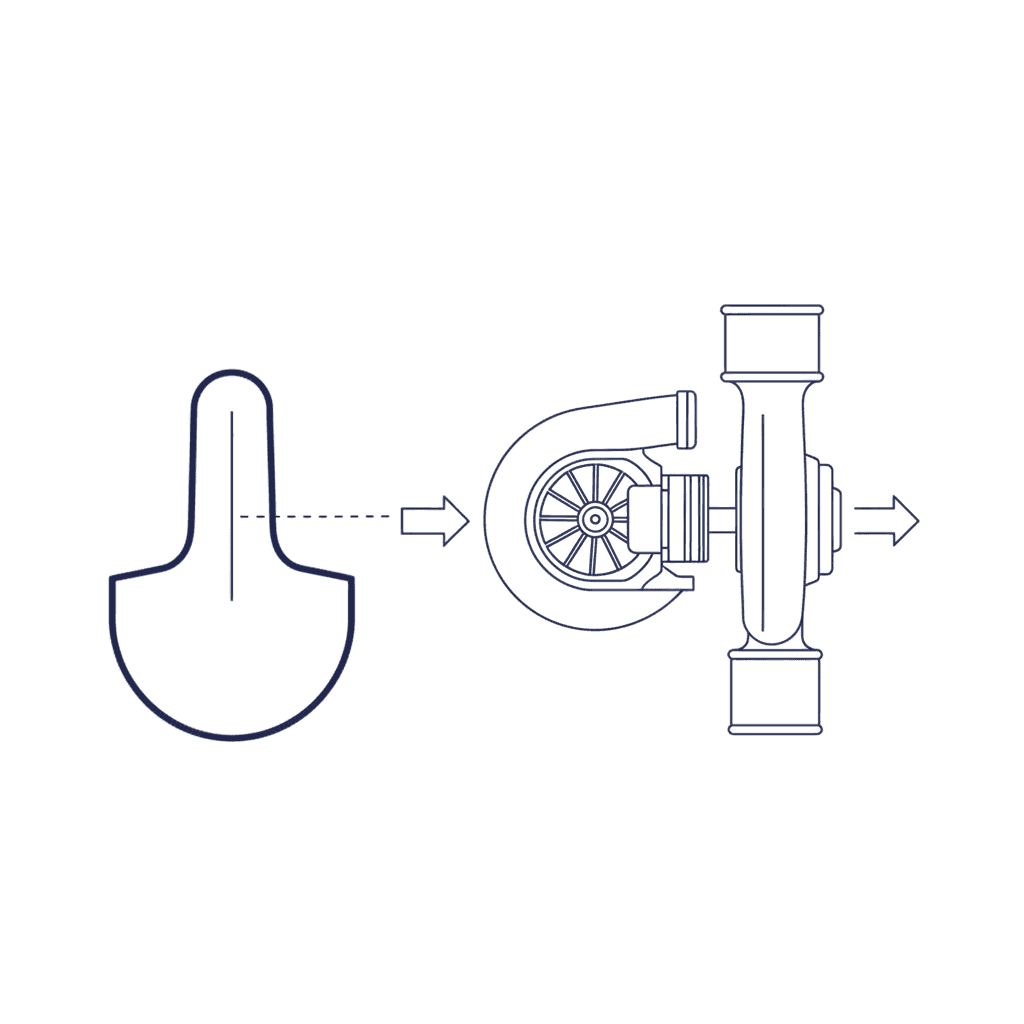
The turbo changes the rules of the game for cam selection. A cam profile that works brilliantly in a naturally aspirated engine can ruin drivability in a turbo engine - and vice versa. It is not just about choosing a "milder" cam, but about understanding how boost and exhaust backpressure affect cylinder filling.
Why turbo and naturally aspirated engines need different cams
In a naturally aspirated engine, valve overlap creates a scavenging effect - the momentum of the exhaust gases helps draw in fresh charge. More overlap gives better cylinder filling at high RPM.
In a turbo engine, two pressures are competing: boost in the intake system and backpressure in the exhaust system. What happens during overlap depends on the relationship between the two:
- Exhaust backpressure higher than boost - exhaust gas gets pushed back through the cylinder and out into the intake. That dilutes the fresh charge with inert exhaust residue, just like internal EGR at full throttle.
- Boost higher than backpressure - charge air blows straight through the cylinder and out through the exhaust valve. That wastes the turbo's work and can overheat the exhaust valves and turbine.
That is why turbo cams have traditionally been designed with a wider lobe separation (112-114°) compared to naturally aspirated cams (106-110°). A wider lobe separation reduces the overlap window and protects against boost leakage.
Asymmetric duration - different on intake and exhaust
Many turbo cams use different duration on the intake and exhaust lobes. PF Racing, who design cams specifically for the turbocharged Volvo B230, call it "dual lobe design", and it is a central part of their turbo cam philosophy.
Two common strategies:
- Shorter exhaust duration - closes the exhaust valve earlier, reduces overlap, prevents boost leakage. Produces cleaner cylinder filling and a smoother boost build-up. Works well for street cars focused on midrange and response.
- Longer exhaust duration - opens the exhaust valve earlier, sends exhaust gas to the turbine faster. Improves spool-up and top end power. But it also produces more overlap and can cost midrange. Used in racing applications with large, efficient turbos.
Modern turbos add nuance to the old way of thinking
The rule "wider lobe separation for turbo" comes from a time when turbos were less efficient and created high exhaust backpressure relative to boost. Bonneville record holder Kenny Duttweiler has shown that with modern, efficient turbo units - where the backpressure ratio is lower - you can run a tighter lobe separation (109°) and still keep a smooth idle with good vacuum.
Kurt Urban, who builds street cars with over 160,000 km on turbo engines, has shown that a relatively mild cam (227/223° at 0.050", 1.27 mm) with a reverse split (more intake duration than exhaust) and a matched 72 mm turbo delivers 1,200 Nm at 3,500 rpm in everyday driving - and the car runs an 11.4 second quarter mile.
The point is that what matters most is not whether the engine is turbocharged, but how well the turbo is sized and how efficiently the exhaust side flows.
Common mistakes when choosing a turbo cam
- "Everyone runs this one" - a cam that works in one specific combination (turbo, manifold, exhaust flow, mapping) is not necessarily right for yours. PF Racing, for example, offers seven different turbo cams from the PF-12T to the PF-5T, each designed for a specific power window.
- Too aggressive a cam on a chipped engine - PF Racing warns that their sharper cams (PF-4T, PF-5T) aren't intended for a lightly tuned standard engine. Too big a cam on an otherwise standard engine costs more than it gives.
- Ignoring the springs - PF Racing's mildest turbo cams (PF-1T, PF-2T) run on stock springs. The PF-3T and up, with 13 mm of lift, need reinforced single springs. Running an aggressive cam with tired stock springs risks valve float and engine failure.
- Skipping the degreeing - the turbo amplifies every degree of misalignment. A couple of degrees of error in cam timing that would barely be noticeable in a naturally aspirated engine can cost noticeable boost and response in a turbo engine.
What information do we need from you?
Kelford Cams, one of the world's leading camshaft manufacturers, uses these questions to match the turbo cam spec:
- Use case - street, track or drag strip?
- Power target - 300 hp and 1,700 hp call for completely different cams
- Rev range - broad midrange or a narrow top end?
- Turbo size and type - a small turbo with quick spool, or a large turbo with high top end power?
- Fuel - petrol, E85, methanol?
- Other modifications - head, intake, exhaust, compression
The answers determine duration, lift, lobe separation and whether an asymmetric profile is needed.
Summary
A turbo engine has different requirements than a naturally aspirated engine. Overlap, lobe separation and asymmetric duration all play a role in how quickly boost builds, how cleanly the cylinder fills, and where in the rev range the power is delivered. The right cam choice, combined with correctly sized turbo, valve springs and accurate degreeing, makes the difference between an engine that delivers and one that disappoints.
Contact Meksta - we will help you find the right turbo cam.
About the author
Robert Wiklund has worked with engines for over 30 years, including for Mazda Rally Team Europe, Toyota Team Europe and GM's rally programme. He founded Meksta in 2023.
Read more about Meksta →Does your engine need reconditioning or tuning?
Contact us for expert advice, whether it is a crankshaft, a turbo upgrade or cylinder boring.