
 Volkswagen
 BMW
BMW MINI
MINI Mercedes
 Ford
Ford Peugeot
 Citroën
 Opel
OpelWhy you must degree your camshaft
Why do you need to degree the camshaft? Inaccurate sprockets, keyways and deck milling can all shift the valve timing. Learn the causes and the tools you need. A guide from Meksta.
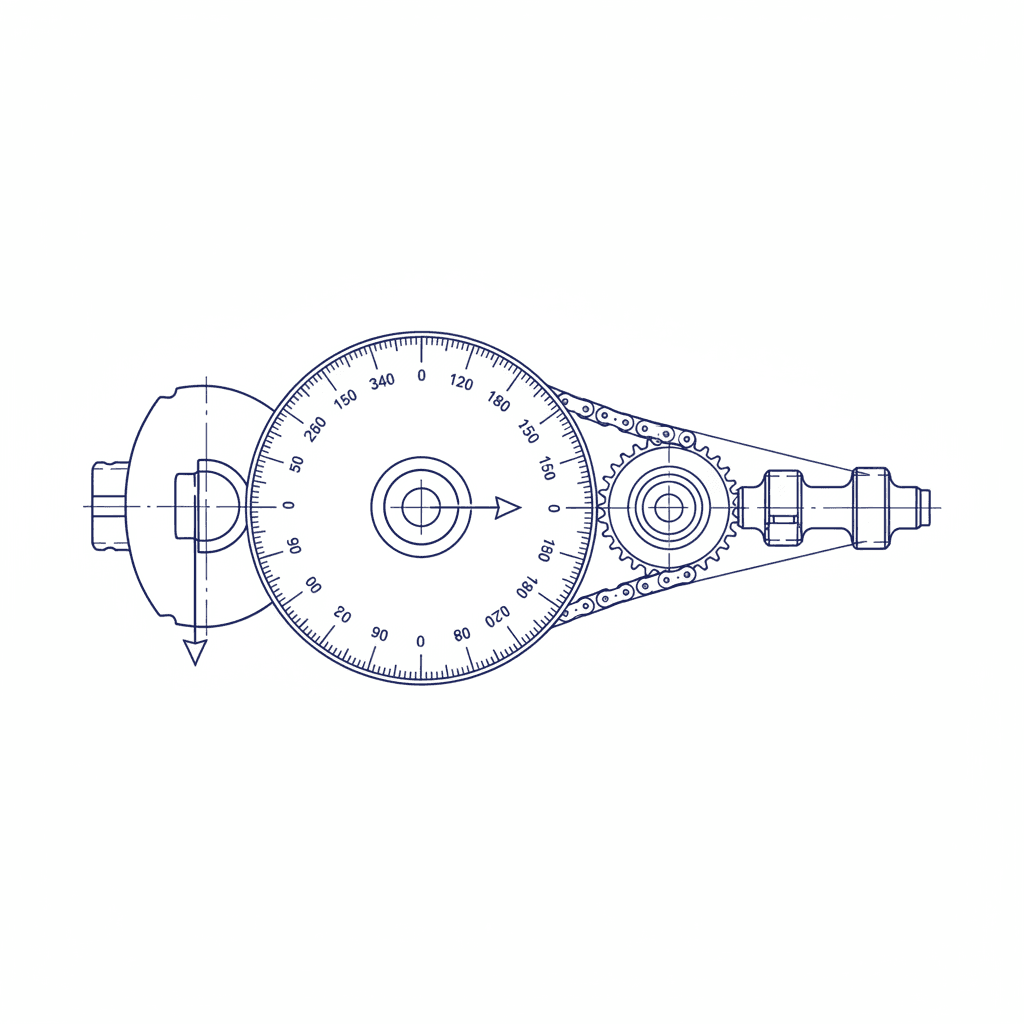
The sole purpose of degreeing your camshaft is to achieve the correct valve opening and closing points for your specific engine. Even if the camshaft is ground to an exact specification, there are other factors that can cause incorrect phasing between the camshaft and the crankshaft.
Common causes of incorrect phasing
- Cam or crank sprockets that are incorrectly marked from the factory
- Keyways that are out of position on the sprockets
- Keyways in the crankshaft that are incorrectly indexed
- On SOHC and DOHC engines: deck milling the cylinder head or the block retards the camshaft
On SOHC engines with rocker arms, the valve stem length, rocker arm geometry and base circle size also affect the lobe separation - and therefore every valve event. Correct degreeing is therefore absolutely critical. Read our step by step guide to degreeing the camshaft.
Tools you need
- Degree wheel - Reveals all the information about the valve timing. Larger wheels give more accurate results.
- Dial indicator with a stand - The stand must be fixed securely to the cylinder head. If the dial indicator has a magnetic base, you can bolt a piece of steel plate to the cam bearings.
- Pointer - A bent coat hanger or a piece of welding wire works fine.
- Piston stop - To precisely establish top dead centre (TDC).
- Cam card - Comes with the camshaft and contains all the specifications you need.
Before you start
Make sure you have carried out all the static measurements and clearance checks: valve to valve, valve to piston, retainer to seal, cam to head casting, cam to connecting rod, seat pressure and clearance to coil bind at full lift. All parts should be clean and lightly oiled.
About the lifters
Always use the correct type of lifter when degreeing. Hydraulic lifters must never be used - they can bleed down and give false readings.
For pushrod engines: buy a mechanical equivalent of your lifter. Use a pushrod with an oil hole so the dial indicator's tip seats properly.
For OHC engines with hydraulic cam buckets (like many modern engines), you need to make a solid lifter that gives 0.1 mm of valve lash on the base circle. The easiest way is to pull the plunger out of a hydraulic lifter and replace it with a piece of steel turned on a lathe.
Remember to put the real hydraulic lifter back afterwards.
Why it matters
Degreeing gives you a correct starting point for the valve timing. Most turbo and highly tuned naturally aspirated engines respond positively to small overlap adjustments - but without correct degreeing as a baseline, you have nothing to work from. A correctly degreed camshaft speeds up the whole tuning process.
Do you have questions about degreeing your camshaft? Contact Meksta and we will help you.
About the author
Robert Wiklund has worked with engines for over 30 years, including for Mazda Rally Team Europe, Toyota Team Europe and GM's rally programme. He founded Meksta in 2023.
Read more about Meksta →Does your engine need reconditioning or tuning?
Contact us for expert advice, whether it is a crankshaft, a turbo upgrade or cylinder boring.