
 Volkswagen
 BMW
BMW MINI
MINI Mercedes
 Ford
Ford Peugeot
 Citroën
 Opel
OpelTiming belt or timing chain: what's the difference?
Timing belt vs timing chain - maintenance, durability, failure risks and how they affect the precision of your valve timing. A guide from Meksta.
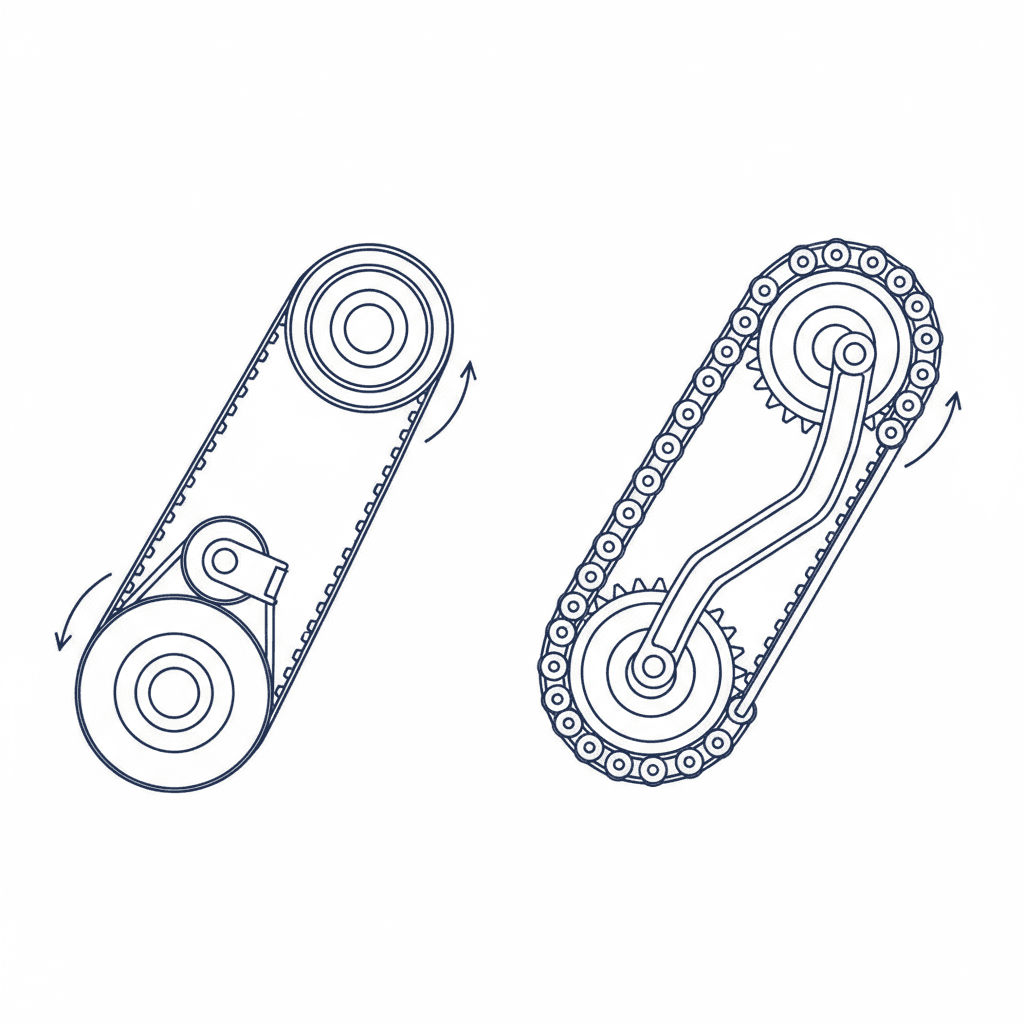
The camshaft has to be driven in sync with the crankshaft - any deviation in timing can cost power, cause rough running or, in the worst case, bend valves. The two main methods of transferring this rotation are the timing belt and the timing chain, and the choice affects maintenance, service life and the risk in the event of a failure.
How they work
Both the timing belt and the timing chain transfer rotation from the crankshaft to the camshaft at exactly a 2:1 ratio - the camshaft turns once for every two crankshaft turns. The difference lies in the construction:
- Timing belt - a reinforced rubber belt with teeth that engage with toothed wheels (sprockets) on the crankshaft and camshaft. Quiet, lightweight and needs no lubrication. Common on modern four-cylinder engines.
- Timing chain - a metal chain (roller or silent chain) that runs in a closed system lubricated by the engine oil. Heavier and more expensive to replace, but designed for a longer service life. Standard on most V-engines and modern direct-injection engines.
Maintenance intervals
The key practical difference:
- Timing belt - has a defined service life. Manufacturers typically specify 80,000-160,000 km or 5-10 years, depending on the engine. Rubber ages regardless of mileage - a belt that has been in place for 10 years can fail even with low mileage. The replacement job often includes the tensioner, idler pulley and water pump.
- Timing chain - designed to last the life of the engine under normal conditions. But the chain stretches over time, and the chain tensioner and guide rails wear. Symptoms of a worn chain: a rattling noise on cold start, altered valve timing, misfires. Oil quality has a direct effect on chain life.
Interference engines: the risk in the event of a failure
This is the critical question. In an interference engine, the valves and piston move through the same space at different times. If the timing link fails - belt or chain - the camshaft stops while the crankshaft keeps turning. The piston hits the open valves.
The result: bent valves, damaged pistons and, in serious cases, a cracked head. A single belt failure can cost a complete cylinder head job or more.
Most modern engines are interference engines - the design gives better compression and combustion. That makes timing belt replacement not optional but mandatory.
Chain failure is rarer but does happen - usually because a worn chain tensioner loses function, the chain skips one or more teeth, and the valve timing shifts enough to cause contact.
Timing precision
From a degreeing standpoint, there are differences:
- Timing belt - minimal stretch over its service life. Timing accuracy is essentially constant from new until replacement. No tooth-to-tooth variation on installation - but the belt's tooth pitch limits fine adjustment (typically 1 tooth equals 4-6 crank degrees on a two-litre four-cylinder).
- Timing chain - stretches progressively over time, which gradually retards the camshaft timing. A new chain holds tight timing, but by 150,000-200,000 km the stretch can become measurable. That affects the intake valve's closing point, and with it the dynamic compression, overlap and power band.
Adjustable cam gears compensate for stretch and allow fine adjustment regardless of drive type.
Gear drive: the third option
In racing and performance builds you will find gear drive, where the camshaft is driven via straight-cut or helical gears directly from the crankshaft. The advantage is zero stretch and exact timing - the drawback is noise (straight-cut) or cost (helical). CatCams, for example, makes gear-driven systems for the VW Golf 16v that replace the original chain drive.
Industry trend
Over the last few decades, the car industry has moved towards the timing chain as standard. The reason is simple: no scheduled service interval for the customer, lower total cost of ownership, and the ability to integrate variable valve timing (VVT), which needs oil-pumped phasers fitted to chain-driven camshafts. But the chain places higher demands on regular oil changes with the correct specification.
Why does this matter when you change your cam?
When you change your camshaft, you should:
- Replace the timing belt, tensioner and idler pulley if the engine is belt-driven - even if the belt "looks fine"
- Inspect the chain, tensioner and guide rails on chain-driven engines - a new aggressive cam that will be run hard deserves a new chain
- Consider an adjustable cam gear regardless of drive type
- Verify the timing precision after installation by degreeing the camshaft - never trust that the marks line up
Summary
The timing belt and timing chain are both reliable when properly maintained. The belt requires scheduled changes but gives quiet running and stable timing over its service life. The chain lasts longer but stretches over time and needs good oil quality to avoid degrading. Whichever type you have - respect the maintenance intervals, and when you change the camshaft, always replace the drive components at the same time.
Contact Meksta if you need help planning your camshaft change.
About the author
Robert Wiklund has worked with engines for over 30 years, including for Mazda Rally Team Europe, Toyota Team Europe and GM's rally programme. He founded Meksta in 2023.
Read more about Meksta →Does your engine need reconditioning or tuning?
Contact us for expert advice, whether it is a crankshaft, a turbo upgrade or cylinder boring.