
 Volkswagen
 BMW
BMW MINI
MINI Mercedes
 Ford
Ford Peugeot
 Citroën
 Opel
OpelReconditioning of racing engines
A competition engine works closer to its limits than any street engine. High revs, long full-load runs and tight tolerances mean every detail has to be right from the start. We recondition and build racing engines with the same method whether the engine will run folkrace, circuit sprints or rally.
Robert has built over 500 performance engines, for everything from road cars to Mazda Rally Team Europe and Toyota Team Europe. That experience shows in the way we work: we measure, document and balance instead of guessing.
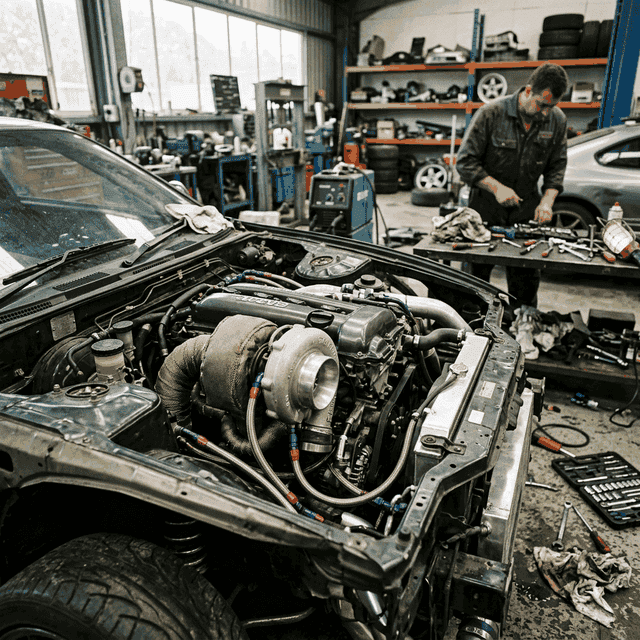
What sets a competition engine apart
Racing engines make different demands than street engines. These are the steps that decide whether a build holds up on track.
Balancing of the rotating assembly
At high revs the smallest imbalance becomes a load on bearings and block. We balance the crankshaft, flywheel and clutch dynamically on our Schenck machine.
Cylinder boring with a torque plate
Competition blocks are bored and honed with a torque plate fitted, so the cylinder bore is round once the cylinder head is in place and the engine is under load.
Cylinder head porting and flow testing
Intake and exhaust ports are shaped and verified on a flow bench. The goal is volumetric efficiency and even flow between the ports, not just bigger passages.
Camshaft grinding
Cam profiles from our own profile library, matched to the regulations and the intended use. Reconditioning, regrinding or new manufacture from a blank.
Resurfacing and sealing
Mating surfaces are milled to documented flatness and the right surface finish for the gasket. Critical when compression is raised and boost is high.
A measurement report on everything
Every build is documented with tolerances and dimensions in an engine sheet that goes with the engine. You know exactly what is inside it.
How a competition build can take shape
Every competition build starts with a conversation about what the engine will be used for: the regulations, the rev range, the power target and the durability requirements. Then we measure what the starting material can take.
Typical work steps
- Disassembly, cleaning and crack testing of block and cylinder head
- Measuring cylinders, crankshaft and valve train against tolerances
- Cylinder boring and honing with a torque plate
- Crankshaft grinding, polishing and dynamic balancing of the whole rotating assembly
- Cylinder head porting and flow testing where needed
- Camshaft grinding to profile and regulations
- Assembly with documented clearances and torque figures
- A measurement report and engine sheet that go with the build
From folkrace to rally
We work on competition engines for everything from folkrace and rallycross to circuit sprints, drifting and historic racing. Tell us which regulations you run under and we will build to suit them.
Common services for racing & competition rebuild
Here are the services most often involved when we rebuild engines for racing & competition.
Balancing
Dynamic balancing of crankshaft, flywheel and clutch as one unit. The foundation for high revs.
Cylinder head porting
Cylinder head porting with flow testing. Shaped for volumetric efficiency, not just bigger passages.
Camshaft grinding
Competition cam profiles from our own profile library. Reconditioning, regrinding and new manufacture.
Cylinder boring
Boring and honing with a torque plate to the right oversize and surface roughness.
Turbo upgrade
Upgraded turbochargers with billet compressor wheels for higher mass air flow.
Racing engines we work with
The guides below cover classic competition and build engines: common faults, reinforcements and what it takes for high power output.
Turbo and rally
Japanese six-cylinder turbo engines
High-revving naturally aspirated engines
Planning a competition build?
Tell us the regulations, the engine and your goals and we will get back to you within 24 hours. Quote after inspection.