
 Volkswagen
 BMW
BMW MINI
MINI Mercedes
 Ford
Ford Peugeot
 Citroën
 Opel
OpelHydraulic lifters vs mechanical lifters
Hydraulic or mechanical lifter? Pump-up, bleed-down, preload, RPM limit and dyno data - understand the difference and choose correctly. A guide from Meksta.
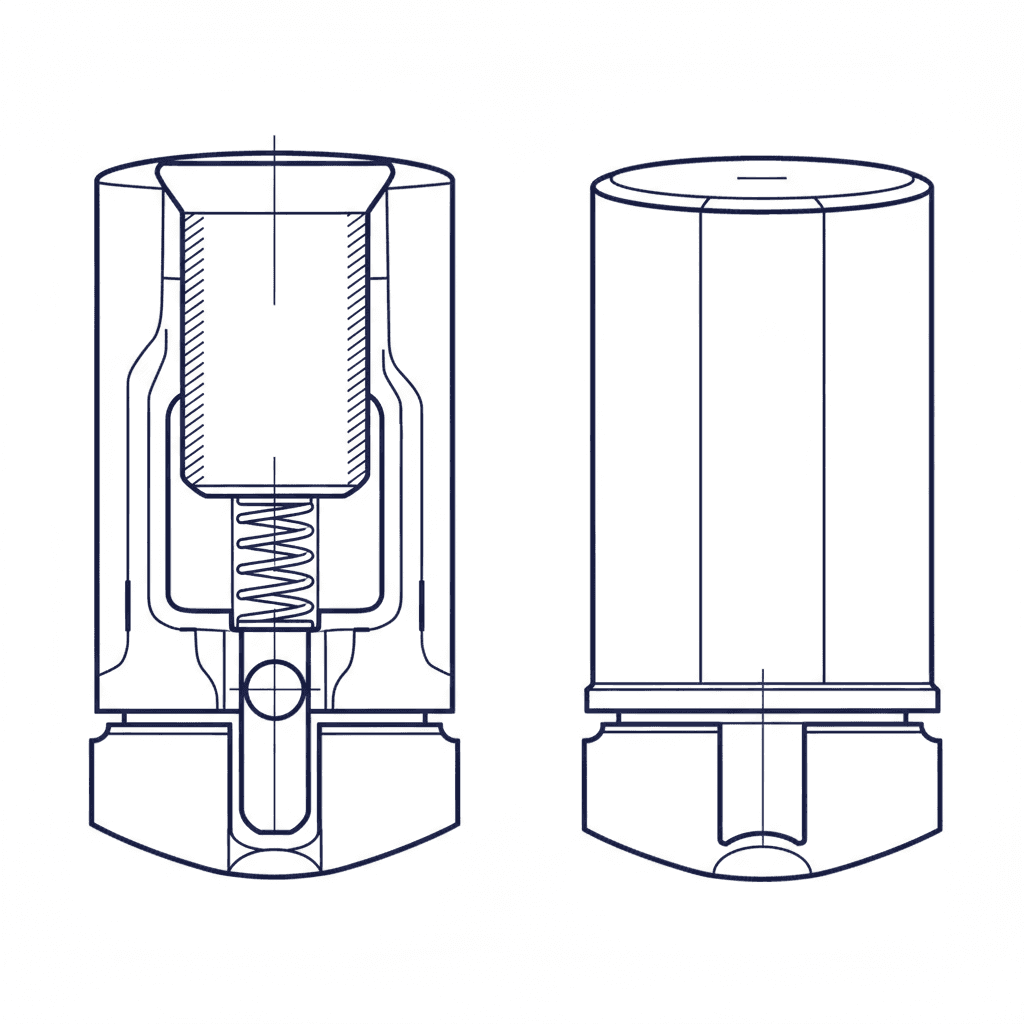
Hydraulic or mechanical (solid), the choice of lifter type affects the engine's character, maintenance needs and RPM capability. Both come in flat tappet and roller versions, but the decisive difference lies in the lifter's internal construction.
How a hydraulic lifter works
Inside a hydraulic lifter there is a piston, a spring and an oil-filled chamber. The engine's oil pressure forces oil into the chamber through a check valve. The piston adjusts itself automatically so that all lash in the valve train is eliminated, which is why hydraulic lifters do not require valve lash adjustment.
COMP Cams describes the chamber as working like a shock absorber: it takes up variations in manufacturing tolerances and thermal expansion, gives quiet running and eliminates manual maintenance. That is precisely why Detroit switched to hydraulic lifters in the 1950s, giving the consumer years of maintenance-free running.
How a mechanical lifter works
A mechanical lifter is essentially a machined steel cylinder with no moving internal parts. There is no automatic adjustment, instead a controlled gap between the rocker arm tip and the valve stem is required, which is called valve lash.
The lash is needed to compensate for thermal expansion and to guarantee that the valve really does close fully when the cam lobe is on the base circle. COMP Cams notes that mechanical lifters produce a characteristic "ticking" sound, especially on cold starts, a sound many performance enthusiasts associate with racing.
Pump-up and bleed-down - the hydraulic lifter's Achilles heel
At high RPM, hydraulic lifters can suffer from two problems:
- Bleed-down - oil is forced past the piston during the lift, which means the lifter does not deliver full duration and lift to the valve. The more aggressive the cam profile and the higher the spring pressure, the more bleed-down.
- Pump-up - if the valve train momentarily unloads (during valve float or spring surge), oil pressure can push the piston up past its normal position. The valve is then held open when it should be closed.
Billy Godbold, head of valve train design at COMP Cams, has tested this on their Spintron (a valve train test rig) and states that genuine pump-up is, in practice, extremely rare. What you usually see is valve bounce, which causes the hydraulic system to self-adjust upward, the lifter reacts to the bounce by filling itself, and can hold the valve open for up to 50 extra crank degrees. Godbold compares the discussion to debating who would win between Bigfoot and the Loch Ness Monster, that is how rare it is.
Ben Herheim at Howard's Cams adds some nuance: pump-up can occur if the system becomes dynamically unstable, usually because of insufficient spring pressure. The fix is stronger springs or a different cam profile.
RPM limit
COMP Cams gives general guidelines for hydraulic lifters:
- Standard hydraulic flat tappet - effective up to 5,500-6,000 rpm
- Anti pump-up lifters - can raise the limit by 500-1,000 rpm
- OEM hydraulic roller - limited to around 6,200 rpm
- Aftermarket hydraulic roller - up to around 6,800 rpm
Mechanical lifters have no built-in RPM limit tied to hydraulics, the limit is instead set by the springs' ability to follow the cam profile. Solid roller cams, the most aggressive variant, are designed for everything from hard street use to all-out racing.
Dyno test: 30 hp from the same "size"
Hot Rod Magazine tested hydraulic vs mechanical flat tappet on a 446 cubic inch (about 7.3 litre) Chrysler wedge with an Edelbrock head and 10.2:1 compression. The camshafts were carefully matched so that idle vacuum, rpm and cranking compression were essentially identical:
- Hydraulic - 520 hp at 5,400 rpm, 755 Nm at 3,800 rpm. The power curve fell away quickly after 5,700 rpm.
- Mechanical - 550 hp at 5,800 rpm, 758 Nm at 3,900 rpm. The curve was clean and stable all the way to 6,300 rpm.
30 hp more, peak power 400 rpm higher, and no part of the rev range where the hydraulic cam had the upper hand. Torque was almost identical through the low and mid range. The difference came entirely at the top end, precisely where the hydraulic lifter's stability starts to fail.
Mechanical lifters as a diagnostic tool
Kill Devil Diesel highlights an often overlooked advantage of mechanical lifters: they reveal problems. If you set the valve lash and it changes, it means something is moving that should not be, a valve stretching from heat, a lobe wearing, a rocker arm vibrating loose.
Hydraulic lifters mask the same problems by compensating automatically. A worn cam lobe or a lifter on its way out can go undetected until it is too late. With mechanical lifters you have a built-in gauge that flags deviations early.
Maintenance - myth vs reality
The most common objection to mechanical lifters is the maintenance requirement. In practice, with modern components (hardened valves, screw-in studs, roller rockers with tool steel cups) there is no reason for the lash to drift if everything is set up correctly from the start. The valve lash needs checking at regular intervals, but that is a matter of minutes with the engine warm and the valve covers off.
Which should you choose?
- Hydraulic - daily driver, turbo car with limited valve cover access, engines that will never see more than 6,000 rpm. Quiet, maintenance-free, trouble-free.
- Mechanical - racing applications, engines that need to rev high, builds where consistency and diagnostics matter. Requires regular valve lash checks.
Summary
Hydraulic lifters give convenience and quiet running. Mechanical lifters give stability, RPM capability and diagnostic transparency. The right lifter type depends on the engine's job, and whichever you choose, the lifters must be matched with the right springs and the right cam profile.
Contact Meksta - we will help you find the right combination.
About the author
Robert Wiklund has worked with engines for over 30 years, including for Mazda Rally Team Europe, Toyota Team Europe and GM's rally programme. He founded Meksta in 2023.
Read more about Meksta →Does your engine need reconditioning or tuning?
Contact us for expert advice, whether it is a crankshaft, a turbo upgrade or cylinder boring.