
 Volkswagen
 BMW
BMW MINI
MINI Mercedes
 Ford
Ford Peugeot
 Citroën
 Opel
OpelFlat tappet vs roller lifters
Flat tappet or roller lifters? Ramp speed, RPM limits, spring requirements and wear differences - the engineering behind choosing your lifter type. A guide from Meksta.
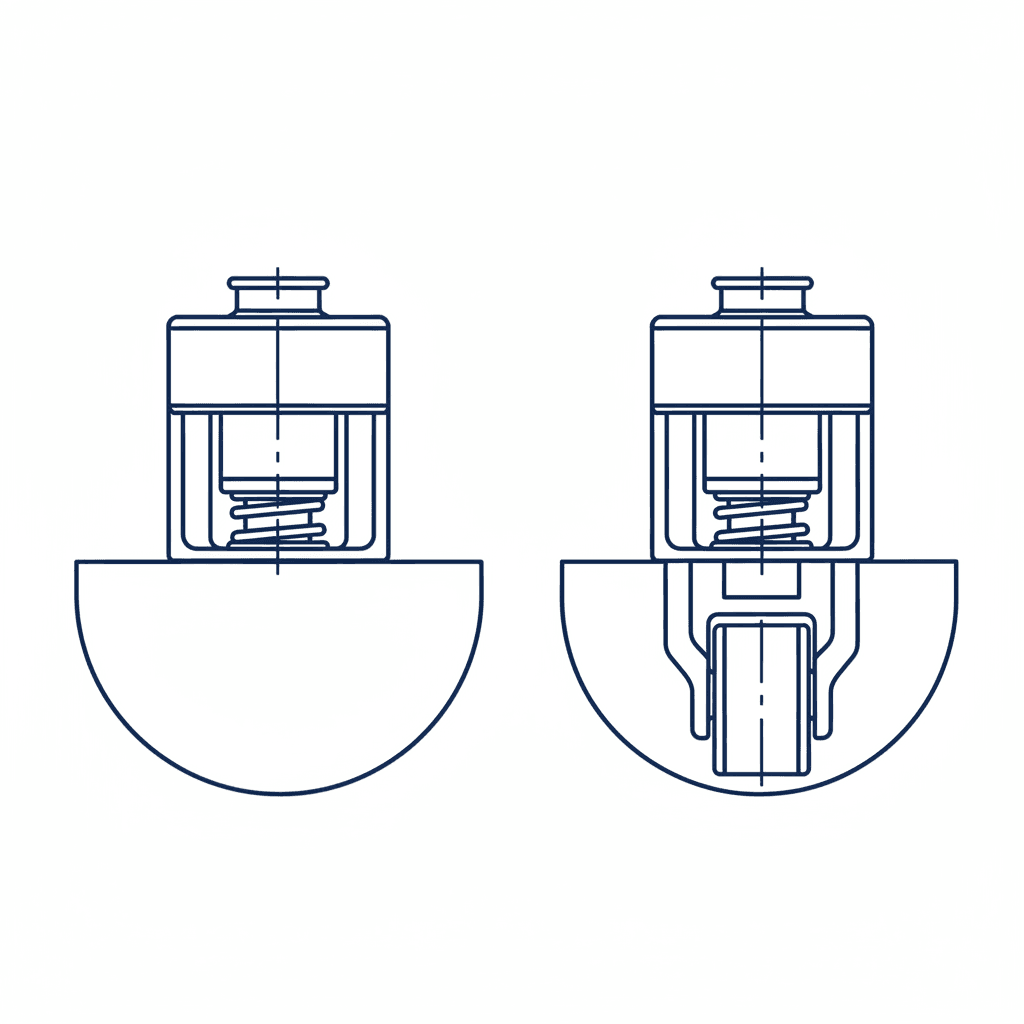
The choice between flat tappet and roller lifters is not about which one is "best", it is about which one suits your engine, your budget and how you use the car. The two types work fundamentally differently against the cam lobe, and that affects everything from cam profile and spring requirements to service life and maintenance.
Mechanical difference: contact surface and motion
A flat tappet lifter has a flat underside that slides directly against the cam lobe. But the surface is not perfectly flat, it has a slight crown (Howard's Cams typically measures a 0.053 mm crown on a standard 21.4 mm lifter). The cam lobe, in turn, has a slight conical taper across its width, typically around 0.097 mm. The crown and the taper work together to make the lifter rotate slowly in its bore, roughly one turn per cam revolution. Without that rotation, point loading occurs and quickly destroys both the lobe and the lifter.
A roller lifter, by contrast, has a small roller (needle bearing) that follows the cam lobe. The contact is rolling instead of sliding, which drastically cuts friction.
Velocity limit - flat tappet's big drawback
Tilden Technologies, which develops cam design software, shows that flat tappet cams have a hard limit: the lifter's maximum velocity is limited by the lifter's diameter. The contact point between lobe and lifter must never reach the lifter's outer edge, as that causes edge loading and failure.
The formula is simple: maximum velocity < (π/180) × (lifter radius - 0.6 mm safety margin). For a Chevrolet with a 21.4 mm lifter, that works out to roughly 0.006 inches (about 0.15 mm) per cam degree. A roller lifter doesn't have this limitation - the roller can follow far steeper ramps.
This is the real technical reason roller cams can open the valve faster. It is not just a case of the profile "being sharper", the flat tappet design has a physical limit that the roller does not.
Ramp speed and area under the curve
Because a roller cam can have faster opening and closing ramps, the valve spends more time at high lift. COMP Cams describes it as roller cams having faster lobe ramps that allow more aggressive profiles: the valve opens faster, stays open longer at maximum lift, and closes faster. That gives more area under the lift curve at the same duration, which means better cylinder filling.
Kill Devil Diesel, which builds performance diesels with solid roller cams, quantifies the difference: at the same duration at 0.050" (1.27 mm), a solid roller can deliver up to 30% more airflow into the cylinder compared with a hydraulic cam, thanks to the larger area under the curve.
Spring requirements differ sharply
The faster ramps of a roller cam place higher demands on the valve springs. According to OnAllCylinders and Lunati, typical spring pressures for flat tappet cams are:
- Hydraulic flat tappet - seat pressure under 60 kg, max open pressure around 160 kg
- Mechanical flat tappet - seat pressure under 73 kg, max open pressure around 175 kg
Roller cams, by contrast, can be run with open pressures of 225-360 kg at maximum lift, because there is no sliding contact at risk of wearing the cam lobe. Kelford Cams warns that flat tappet cams should never be run with a higher open pressure than the manufacturer specifies, the sliding contact between lobe and lifter cannot take the same load as a roller contact.
Break-in and ZDDP
Flat tappet cams require a critical break-in procedure, 20 minutes at 2,000-2,500 rpm with ZDDP-rich oil, so that the lobe and lifter can form a hardened contact surface. COMP Cams stresses that flat tappet lifters can only be used with one camshaft, the wear creates a unique pattern that cannot be transferred.
Roller lifters need no break-in and can be reused with new camshafts, even though they cost more per unit.
Friction and power
OnAllCylinders notes that the difference in internal friction between flat tappet and roller lifters is surprisingly small, maybe 5 hp. The real gain with a roller cam is not reduced friction, but the ability to run more aggressive profiles.
In Hot Rod Magazine's dyno test of a 446 cubic inch (about 7.3 litre) engine with matched flat tappet cams (solid vs hydraulic), the engine delivered 550 hp with the solid flat tappet. A roller cam with the same effective duration had the potential to pull further ahead thanks to faster ramps and more area under the curve.
When flat tappet is still the right choice
- Rulebook - NHRA Stock Eliminator and other classes require flat tappet. It is still the most common cam type in classic engines.
- Budget - a flat tappet cam with lifters costs a fraction of a roller setup. With the right oil, correct break-in and matched springs, flat tappet works perfectly well in street cars.
- Older engine blocks - converting to roller lifters often requires a retrofit kit with a modified base circle, link bars and sometimes machining of the block.
When roller lifters are better
- High RPM - the roller's freedom from the velocity limit means the cam profile can be more aggressive at the top of the rev range.
- Turbo - turbo engines benefit from fast valve opening and cleaner cylinder filling.
- Long-term reliability - no break-in hassle, reusable lifters, lower wear.
- Modern engines - COMP Cams notes that there is not a single production car model today that ships with flat tappet.
Summary
Flat tappet and roller lifters are not better or worse than each other, they simply have different physical limitations. Flat tappet is limited by the lifter diameter's velocity limit and requires careful break-in and ZDDP-rich oil. Roller lifters give freer profile design and more aggressive ramps, but cost more and need stronger springs. The right choice depends on the engine, the budget and how you use it.
Contact Meksta - we will help you choose the right cam type for your build.
About the author
Robert Wiklund has worked with engines for over 30 years, including for Mazda Rally Team Europe, Toyota Team Europe and GM's rally programme. He founded Meksta in 2023.
Read more about Meksta →Does your engine need reconditioning or tuning?
Contact us for expert advice, whether it is a crankshaft, a turbo upgrade or cylinder boring.