
BMW M30 Rebuild, common faults & everything you need to know
Complete guide to BMWs legendary big inline-6. 27 years of production, a motorsport heritage and one of the strongest bottom ends in its class.
BMW M30 - 27 years in production (1968-1994), the basis for the S38 (M5 engine). From the E9 3.0 CSL to the E34 535i - the M30 powered BMWs six-cylinder cars for almost three decades. Cast iron block, timing chain drive and a bottom end known for taking enormous loads. The basis for the S38 (M5 engine). We do everything from cylinder head reconditioning to complete engine reconditioning with a 12-month warranty.
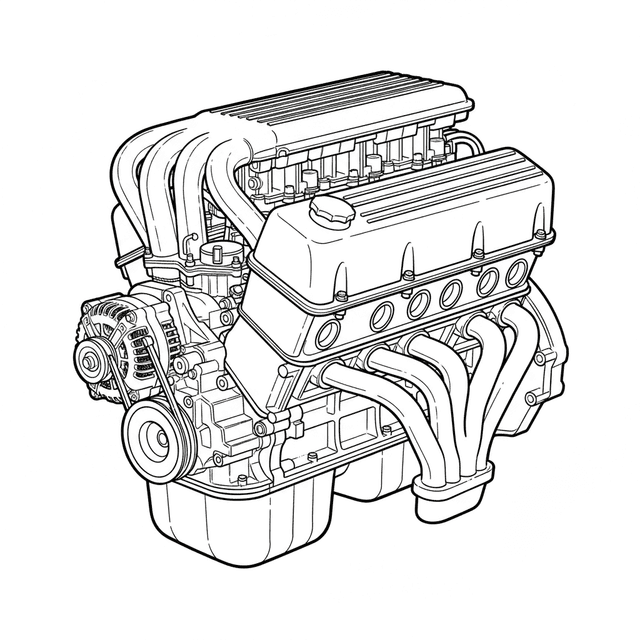
BMW M30 at a glance
All dimensions and data for the M30 series. The M30 is BMWs longest-produced inline-6 - 1968 to 1995.
| Variant | Volume | Bore/Stroke | Power | Torque | Note |
|---|---|---|---|---|---|
| M30B28 | 2.8L | 86 × 80 | 184 hk | 240 Nm | 528i, 728i, 628CSi |
| M30B30 | 3.0L | 89 × 80 | 200 hk | 272 Nm | 3.0 CSi/CSL, 530i, 730i |
| M30B32 | 3.2L | 89 × 86 | 197 hk | 285 Nm | 533i, 633CSi, 733i |
| M30B34 | 3.4L | 92 × 86 | 218 hk | 310 Nm | 535i, 635CSi, 735i |
| M30B35 | 3.4L | 92 × 86 | 211 hk | 305 Nm | 535i (E34), 735i (E32) |
| M106 Turbo | 3.4L | 92 × 86 | 252 hk | 380 Nm | 745i (Europa) |
Torque specs
Verified against the BMW N 600 factory standard (AZD11) and Haynes BMW 3/5 Series (ISBN 1 85960 236 3) ch. 2A/2B. Where they differ, N 600 wins. Clean and oil new bolts per BMW where tightening is to an angle or in multiple stages.
Cylinder head & valvetrain
Engine block & bottom end
Timing chain & timing (M30 = chain, not belt)
Lubrication system
Intake, exhaust, other
Turbo (M30 Turbo / 745i, M106)
A dedicated procedure for the Garrett T03 installation in the E23 745i. All values apply only to the turbo variant. Apply Molykote HSC paste to the exhaust nuts and studs on assembly.
NOTE - the M30 has a timing chain, not a timing belt: This is the biggest difference from the M20. The tensioner and guide rail wear over time, but the chain usually gives an audible warning (rattle on cold start) before failure. The chain tensioner plug M22x1,5 is torqued to 40 Nm, the plunger cylinder M26x1,5 to 50 Nm.
NOTE - Pre-87 (B34) vs post-87 (B35): N 600 4AZ gives an identical procedure for both (60 + 20 min + 80 + 25 min + 35°). Haynes lists an older multi-stage method for pre-87 (40 + 60 + 25° + 25° + 25°). Identify the engine from the serial number before choosing a procedure. When in doubt, follow N 600.
NOTE - Connecting rod bolts 55 Nm straight: The M30 (and M10) are the last BMW sixes with a straight torque and no angle addition. From the M20 onwards TTY bolts are used (5 Nm seat + 20 Nm + 70°). The bolts should still always be replaced on disassembly per 1AZ.
NOTE - Harmonic balancer M24x1,5 / 440 Nm: Among the M30s absolute top torques. It requires a heavy-duty torque wrench and a holding tool (BMW 11 2 150) to lock the crankshaft. The central bolt is always replaced.
NOTE - Turbo (745i) re-torque after 2000 km: The exhaust nuts must be loosened first, then torqued to 15 Nm. The order of the procedure is critical so as not to overload the studs. Always use Molykote HSC paste when fitting new studs and exhaust nuts.
Factory tolerances & wear limits
Original values from Haynes BMW 3/5 Series ch. 2B-2 (General engine overhaul). M30-relevant rows.
The cylinder head in detail
The M30s aluminium head sits on a cast iron block - an architecture that delivers fine performance but demands flawless cooling. Detailed dimensions for resurfacing, valve reconditioning and inspection during a cylinder head reconditioning.
M30-specific cylinder head faults we see often:
- Cracks between valve seats cylinder 5-6: Most common after overheating. The thermal expansion of the aluminium against the cast iron block puts the greatest load on the rear cylinder pair. Always pressure test at rebuild.
- Head gasket leak between cylinder 5 and 6: The cold bridge at the rear end plus the adjacent water passage make this the M30s most common gasket failure.
- Camshaft wear at 250 000+ km on E32/E34: Long service intervals plus 5W-40 oil that thins out at high mileage cause wear on the cam lobes. The rocker roller is often visibly polished.
- Rocker arm breakage (uncommon): Occurs mainly with over-revving or a worn-out valve spring. Inspect the rocker shaft during a cylinder head reconditioning.
- Valve guide wear on high-mileage examples: Blue smoke on cold start or after overrun. Requires new guides and seat cutting at rebuild.
Common faults on the BMW M30
This is what we see most often. The cooling system is the M30s weakest point - a single overheating episode can ruin the cylinder head.
Cooling system collapse & overheating
Age-related • Critical- Symptoms
- Overheating, sudden coolant loss, temperature warning. Can lead to permanent damage to the cylinder head.
- Cause
- Aluminium expands 1,7x faster than cast iron when heated. Water pump with a plastic impeller, thermostat, the radiators plastic parts, expansion tank - everything becomes brittle with age. A single overheating can crack the cylinder head.
Cracks in the cylinder head
Common • High- Symptoms
- Coolant loss without a visible leak, white smoke, oil emulsion, dropping coolant level.
- Cause
- The M30s aluminium head is known for cracking between the valve seats and in the combustion chamber. Often caused by overheating. The cracks can be internal - always pressure test.
Timing chain slap
200 000+ km • Medium- Symptoms
- Rattling noise on cold start, changed valve timing, in serious cases the chain jumping.
- Cause
- The timing chain stretches over time. The tensioner and guide rail wear. Unlike the M20s timing belt, the chain usually gives an audible warning before failure.
Oil leak
Very common • Medium- Symptoms
- Oil traces under the car, oil around the valve cover, oil pan, rear main seal.
- Cause
- Oil leaks are very common on the M30, especially on older examples. The valve cover gasket is the easiest to fix. The rear main seal takes the most work. The timing cover gasket can also leak.
Exhaust manifold cracking
Age-related • Medium- Symptoms
- A ticking/clicking noise that increases with temperature, exhaust smell in the engine bay.
- Cause
- The cast iron manifold cracks from thermal cycling. Exhaust manifold bolts rust and snap - common in humid climates.
Cylinder & crankshaft wear
300 000+ km • High- Symptoms
- Rising oil consumption, blue smoke under acceleration, knocking from the lower engine under load.
- Cause
- Natural wear of the cylinder bores, crankshaft bearings and piston rings after high mileage. The M30 is robust - but after 300 000 km block work is normal.
M30 Rebuild Prices
Price range based on the 6-cylinder M30 inline. SOHC 12-valve cylinder head, cast iron block. All prices excl. VAT and parts.
Cylinder head reconditioning
Bottom end
Full rebuild
Performance
The price covers machining work only. Parts and assembly/disassembly labour are charged separately.
NOTE: The BMW M30 is a big 6-cylinder engine (up to 3.5L). The final price depends on the variant (B28/B30/B34/B35), the condition of the engine and any performance upgrades. Contact us for an exact quote.
Tuning the M30
The M30 is legendary as a turbo platform. The cast iron block with a large displacement (up to 3.5L) gives a perfect base for serious builds. The same architecture as the S38 (M5 engine).
- 1
NA optimisation
Chip tuning (+24 hp), sports air filter, exhaust system. The M30 head flows well from the factory.
230-245 hk - 2
Camshaft + porting
Schrick 280/284° camshaft - or custom ground from a blank via our cam grinding. Cylinder head porting, 3-angle valve seat. Maximum NA potential out of the M30.
250-265 hk - 3
Turbo conversion
Garrett GT35, Holset HX35/HX40 or KKK K27 (period-correct) - see turbo upgrade. Standalone ECU and mapping, fuel system, intercooler. Engines from 1987 (9.0:1) suit best.
330-400 hk - 4
Stroker + forged internals
95/98 mm stroker crankshaft (4340 steel), forged pistons + connecting rods, ARP bolts. Up to 4.2L displacement. Requires cylinder boring and cylinder head resurfacing of the block and head.
500-800+ hk
M30 Camshaft Profiles
We grind our own camshaft profiles for the BMW M30 from a blank, on our own camshaft grinder. Every shaft is supplied with a complete grinding report. The M30 is a SOHC engine with timing chain drive - a single camshaft operates all twelve valves.
The M30s longer 6-cylinder shaft and the need for precision at higher lift make manufacturing more demanding. All profiles keep the original base circle. From M33 and up, uprated valve springs are recommended.
M3x-serien Original base circle
| Profile | Stage | Application | Working range | Duration / Lift |
|---|---|---|---|---|
| M31Street | Standard | Daily driving | 800-6 000 v/m | 252° / 9.8 mm |
| M32Street+ | Stage 1 | Sport / cruise | 1 200-6 400 v/m | 260° / 10.5 mm |
| M33Race+ | Stage 3 | Sprint / track | 2 000-6 800 v/m | 268° / 11.2 mm |
| M34Drag | Stage 3+ | Track only | 2 800-7 200 v/m | 276° / 11.8 mm |
Questions & answers about the BMW M30
What we hear most often from M30 owners.
What does it cost to rebuild a BMW M30?
A cylinder head reconditioning costs approx. 7 500 - 10 000 SEK (labour), a complete engine rebuild approx. 30 000 - 50 000 SEK. The M30 is a big 6-cylinder engine (up to 3.5L) - the final price depends on the variant and condition.
Does the M30 use a timing belt or a timing chain?
The M30 uses a timing chain, unlike the smaller M20 which uses a timing belt. The chain is more durable but requires maintenance - the tensioner and guide rail wear over time. The chain usually gives an audible warning (rattling on cold start) before it needs replacing.
How much power can an M30 handle?
The M30 is known for its strong bottom end. Stock bearings handle ~400 hp with a turbo. The stock connecting rods are the weak link at ~600 hp. With forged internals and a stroker kit (up to 4.2L): 800+ hp. The same block architecture is used in the S38 (M5).
Which M30 variant is best to build on?
The M30B35 (3.4L, 92 mm bore) gives the largest displacement in standard form and has 9.0:1 compression - perfect for a turbo. The M30B34 (same block, 10.0:1) requires lower compression for a turbo installation.
M30 vs M20 - what is the difference?
Both are SOHC 12v inline-6. The M30 is physically larger (2.5-3.5L vs 2.0-2.7L), heavier (~190 vs ~170 kg) and uses a timing chain instead of a timing belt. The M30 has a stronger bottom end and higher power potential. The M20 was fitted to the E21/E30/E28/E34, the M30 to the E24/E28/E32/E34.
How long does a rebuilt M30 last?
The M30 is known for exceptional longevity - 400 000+ km with good maintenance. A correctly rebuilt M30 lasts just as long. Most important: keep the cooling system perfect. A single overheating can ruin the aluminium cylinder head.
Do you have an M30 that needs looking at?
Call us directly or send in a quote request. We reply within 24 hours.
Other engines we recondition
We recondition more engines than we have time to write guides about. Here are more that we see often.