
BMW M20 Rebuild, common faults & everything you need to know
Complete guide to BMWs small inline-6. From timing belt changes to turbo builds - with workshop prices.
BMW M20 - the classic inline-6 that defined the E30 era. Cast iron block with an aluminium cylinder head, SOHC timing belt drive and the characteristic smooth power delivery only a straight six gives. The M20B25 (325i) is the most common variant and one of the most popular engines to turbo convert. We do everything from cylinder head reconditioning to complete engine reconditioning with a 12-month warranty.
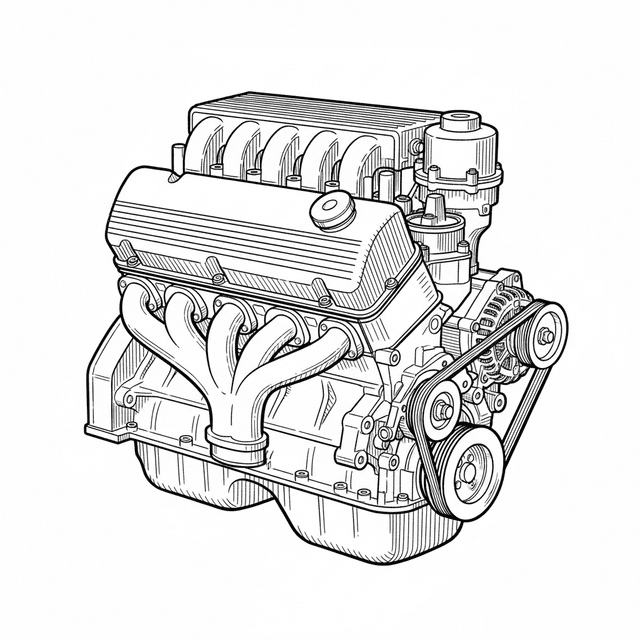
BMW M20 at a glance
All dimensions and data for the M20 series. Shared specifications for all M20 variants.
| Variant | Volume | Bore/Stroke | Power | Torque | Note |
|---|---|---|---|---|---|
| M20B20 | 2.0L | 80 × 66 | 129 hk | 174 Nm | 320i, 520i |
| M20B23 | 2.3L | 80 × 76.8 | 150 hk | 205 Nm | 323i (E21/E30) |
| M20B25 | 2.5L | 84 × 75 | 171 hk | 226 Nm | 325i, 525i, Z1 |
| M20B27 eta | 2.7L | 84 × 81 | 125 hk | 240 Nm | 325e, 528e (low rpm) |
Torque specs
Verified against BMW Werkstatthandbuch N 600 (Engine 11.xx, AZD11) and Haynes BMW 3- & 5-Series Chapter 2A/2B. Where the sources conflict, the factory spec (N 600) wins. The M20 is an interference engine with a timing belt - all TTY bolts (cylinder head, connecting rod) are replaced at rebuild.
Cylinder head & valvetrain
Engine block & bottom end
Timing belt & timing
Lubrication system
Intake, exhaust, other
NOTE - Cylinder head bolts (hex vs Torx): Early M20 (pre-1987) used hex M11 bolts with a longer heat cycle procedure. Later M20 (1987+) uses Torx M10. Visual identification: look at the bolt head - hex = early, Torx star = late. BMW always prescribes changing to Torx bolts at rebuild. Cylinder head bolts are single-use (TTY).
NOTE - Connecting rod bolts (TTY): The factory N 600 procedure is 5 Nm seating torque (set the bolt in place) + 20 Nm + 70° angle. Haynes lists "22 Nm" as the only value - that is a misreading; the angle tightening gives a final clamp load well above 22 Nm. Follow N 600 strictly and always replace the connecting rod bolts.
NOTE - Harmonic balancer hub (410 Nm): This is BMW's factory spec (N 600) for M20/M21/M50/M52/S50 US/S52. A common but incorrect figure that circulates is 310 Nm. The factory wins: 410 Nm with a new M18 x 1,5 bolt. Use a crankshaft lock via the flywheel starter ring.
NOTE - Interference engine: The M20 is "tight tolerance" - a timing belt failure means bent valves in practically 100 % of cases. Total valve damage. A timing belt change every 60 000 km or 4 years is mandatory. Tensioner, idler pulley and water pump are replaced together with the belt.
NOTE - The intermediate shaft: A unique M20 detail. The intermediate shaft sprocket meshes with the timing belt and drives the oil pump and distributor. When changing the belt, the intermediate shaft timing marks must line up correctly with the crank sprocket, otherwise misfires and loss of compression.
Factory tolerances & wear limits
Original values from Haynes Chapter 2B General overhaul. All dimensions in mm. Wear limit = replace/recondition at or above the value.
The cylinder head in detail
The M20 cylinder head is a cast aluminium piece, SOHC with 12 valves (2 per cylinder) and hydraulic rockers. The head sits on a cast iron block - which is the source of most thermal problems on the M20. The values below are the factory spec for rebuild inspection.
Typical M20 cylinder head faults: Warping at cylinder 6 after overheating - the M20 has poor coolant circulation at the rear, and cylinder 6 runs the hottest. Cracking between the valve seats is classic on overheated examples. Above > 0,30 mm skimming a new head is required - we always measure the head height before resurfacing.
Valve guide wear: Common over 200 000 km. The exhaust valve runs considerably hotter than the intake and the exhaust guide wears faster - hence the larger oil clearance from the factory (0,04-0,07 vs 0,02-0,05 mm). At a measured clearance above 0,15 mm (intake) or 0,18 mm (exhaust) new guides are required, followed by valve seat cutting.
Cylinder head bolt threads in the block: On the cast iron block the bolt threads can pull out after repeated rebuilds or overtightening. A Helicoil or Time-Sert is needed if the thread hole is damaged. Always check thread depth and clean the threads before running a new TTY procedure.
Common faults on the BMW M20
This is what we see most often when an M20 comes in. The cooling system is the biggest culprit - and the timing belt must be respected.
Timing belt failure (interference engine)
100 000 km • Critical- Symptoms
- The engine stops suddenly or will not start. On failure: bent valves, damaged pistons, potentially total engine failure.
- Cause
- All M20 variants are interference engines. BMW specifies 100 000 km or 5 years - always replace the water pump, tensioner and idler pulley at the same time. The front seal can leak oil onto the belt.
Head gasket / cracks in the cylinder head
Common • High- Symptoms
- Overheating, white smoke, coolant in the oil, oil film on the coolant.
- Cause
- Thermal expansion difference between the aluminium head and the cast iron block. The M20 head is known for cracking around the coolant passages - which can be worse than the gasket itself. Always pressure test.
Cooling system collapse
Age-related • High- Symptoms
- Overheating, sudden coolant loss, cracks in the expansion tank.
- Cause
- The plastic parts in the cooling system become brittle with age: expansion tank, thermostat housing, radiator end tanks, water pump. The whole cooling system should be treated as a wear item on these engines.
Oil leak
All mileages • Medium- Symptoms
- Oil traces under the car, oil around the valve cover, oil pan, rear main seal.
- Cause
- The valve cover gasket (cork/composite) dries out. The oil pan gasket hardens. The front crank seal can leak oil onto the timing belt - dangerous.
Idle control valve (ICV)
Common • Medium- Symptoms
- Rough idle, the engine dies at a stop, the idle speed surges up and down.
- Cause
- The idle control valve (Bosch ICV) clogs up with carbon deposits. It can often be cleaned with carburettor cleaner. Replace if needed.
Cylinder wear & bottom-end health
250 000+ km • High- Symptoms
- Rising oil consumption (>0.5 L/1000 km), blue smoke under acceleration, knocking noise from the lower engine under load.
- Cause
- Normal wear of the cylinder bores and crankshaft bearings after high mileage. Made worse by short trips, oil starvation and previous overheating.
M20 Rebuild Prices
Price range based on the 6-cylinder M20 inline. SOHC 12-valve cylinder head, cast iron block. All prices excl. VAT and parts.
Cylinder head reconditioning
Bottom end
Full rebuild
Performance
The price covers machining work only. Parts and assembly/disassembly labour are charged separately.
NOTE: The BMW M20 is a 6-cylinder engine. The final price depends on the condition of the engine, the variant (B20/B23/B25/B27) and any performance upgrades. Contact us for an exact quote.
Tuning the M20
The M20 is one of the most popular BMW engines to turbo convert. The cast iron block is strong, and the simple SOHC design leaves plenty of room for a turbo installation.
- 1
NA optimisation
Chip tuning (Turner/Conforti), sports air filter, exhaust system. Modest but noticeable gains on a naturally aspirated engine.
180-190 hk - 2
Camshaft + porting
Schrick 284° camshaft (or custom ground - see our camshaft grinding), porting of the "885" head, 3-angle valve seat, intake/exhaust. The best NA steps.
190-210 hk - 3
Turbo conversion
Holset HX35/HX40 or Garrett T3/T4 hybrid (see turbo upgrade). MegaSquirt standalone ECU and mapping, fuel system, injectors, intercooler.
300-400 hk - 4
Reinforced internals
Forged pistons (8.5:1), forged connecting rods, ARP bolts, O-ringed block (requires cylinder boring + cylinder head resurfacing), welded coolant passages in the cylinder head.
400-450+ hk
M20 Camshaft Profiles
We grind our own camshaft profiles for the BMW M20 from a blank, on our own camshaft grinder. Every shaft is supplied with a complete grinding report. The M20 is a SOHC engine with timing belt drive - a single camshaft operates all twelve valves via a rocker arm system.
All profiles keep the original base circle and can be run with standard followers. From M23 and up, uprated valve springs are recommended to avoid valve float at high rpm.
M2x-serien Original base circle
| Profile | Stage | Application | Working range | Duration / Lift |
|---|---|---|---|---|
| M21Street | Standard | Daily driving | 800-6 200 v/m | 248° / 9.6 mm |
| M22Street+ | Stage 1 | Sport / cruise | 1 200-6 600 v/m | 256° / 10.2 mm |
| M23Race | Stage 2 | Road racing | 1 800-7 000 v/m | 264° / 10.8 mm |
| M24Race+ | Stage 3 | Sprint / track | 2 500-7 400 v/m | 272° / 11.4 mm |
| M25Drag | Stage 3+ | Track only | 3 200-7 800 v/m | 280° / 12.0 mm |
Questions & answers about the BMW M20
What we hear most often from M20 owners.
What does it cost to rebuild a BMW M20?
A cylinder head reconditioning costs approx. 7 000 - 9 500 SEK (labour), a complete engine rebuild approx. 28 000 - 45 000 SEK. Parts come on top of that (gasket, bearings, piston rings etc.).
Is the BMW M20 an interference engine?
Yes, all M20 variants are interference engines with timing belt drive. If the belt snaps, the valves hit the pistons. BMW recommends a change every 100 000 km or 5 years. Always replace the water pump, tensioner and idler pulley at the same time.
Which M20 variant is best?
The M20B25 (2.5L, 325i) is the most common and popular variant. Strongest as standard (171 hp) and best supported by the aftermarket. The "885" head has the best flow. The M20B27 eta has the most torque but the lowest power.
Can you turbo convert an M20?
Absolutely. The M20 is one of the most popular BMW engines for turbo builds. The cast iron block is strong and the simple SOHC design gives room. ~300 hp on stock bearings, 400+ hp with forged internals.
M20 vs M50 - which should I choose?
The M50 (DOHC 24v, timing chain) replaced the M20 in 1990. The M50 has better top-end power and VANOS. The M20 is simpler, cheaper to rebuild and easier to turbo convert. Choose the M20 for budget turbo builds, the M50 for NA performance.
How long does a rebuilt M20 last?
With a correct rebuild and regular maintenance: 200 000+ km. The cast iron block is extremely durable. Change the timing belt on schedule and keep the cooling system in good order - overheating is the M20s worst enemy.
Do you have an M20 that needs looking at?
Call us directly or send in a quote request. We reply within 24 hours.
Other engines we recondition
We recondition more engines than we have time to write guides about. Here are more that we see often.