
How much power can you get with a turbo?
Turbocharging can deliver dramatic power gains. But how much more power do you actually get? We set out the facts.
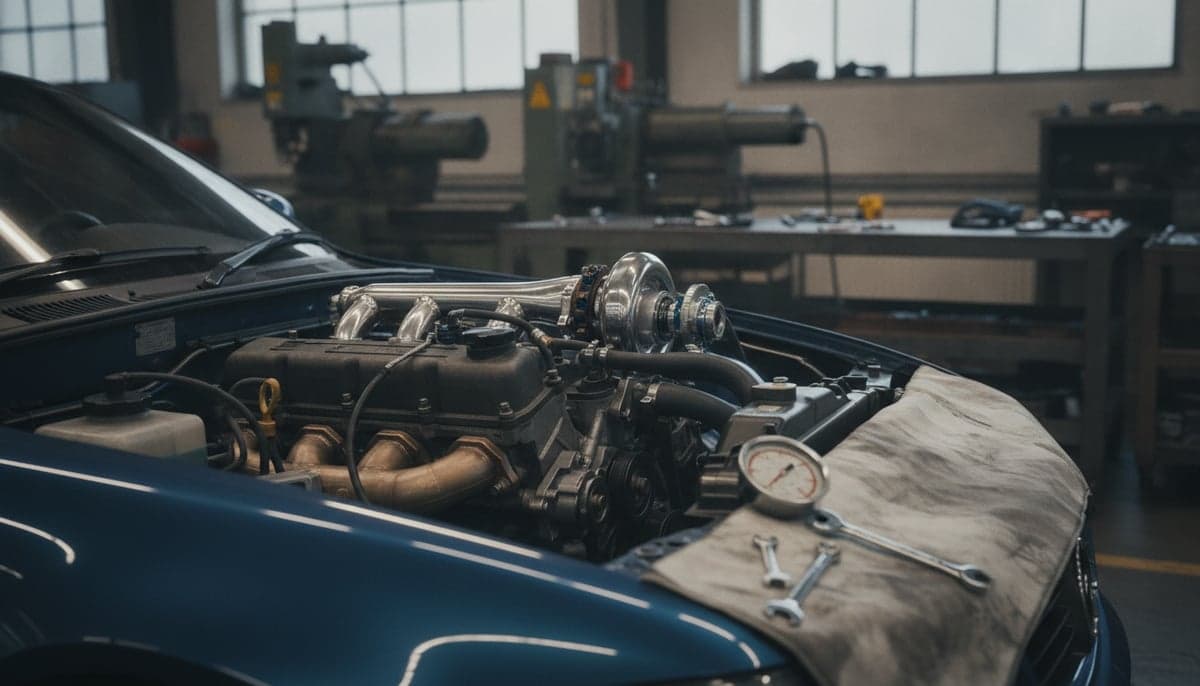
The basic principle: more air = more power
A combustion engine produces power by mixing air with fuel and igniting the mixture. The more air you can force into the cylinder, the more fuel you can burn, and the more power you get. That is the whole point of turbocharging.
A naturally aspirated engine breathes air at normal atmospheric pressure (about 1 bar). A turbocharged engine forces air in at higher pressure, usually between 0.5 and 2.5 bar above atmospheric pressure (boost). Every extra bar of boost increases the available air mass, and with it the power potential.
Guide figures: what can you expect?
The power gain depends on several factors, but here are approximate guide figures based on engine type and level of modification:
Software tuning
For engines that are already turbocharged. An ECU remap can give 15-30% more power just by adjusting boost, fuel and ignition.
Upgraded turbo
A larger turbo combined with upgraded injectors, pump and intercooler. Can give 40-80% more power than standard.
Full engine build
Forged internals, a maximised turbo installation and porting. In extreme cases we are talking 100-300% power gains for racing.
What limits the power?
There are several bottlenecks that decide how much power you can get:
The strength of the engine block
Cast blocks have a limit to how much pressure they can take before they crack. The tolerance varies greatly from one engine to another.
Pistons and connecting rods
Factory parts are not sized for extreme loads. Forged components are a must at higher power levels.
The fuel system
Injectors and pump have a maximum capacity. If the engine is starved of fuel under load, it leads to total failure.
The engine management
The ECU must have enough resolution to control things precisely. Depending on the power target, a standalone management system may be required.
Cooling
More power generates exponentially more heat. Without cooling that is sized for it, the engine risks overheating and knock.
The drivetrain
The clutch, gearbox and driveshafts have to be able to put the increased torque down to the tarmac without breaking.
Boost and power - a rule of thumb
As a rough rule of thumb, each bar of boost (above atmospheric pressure) roughly doubles the available air mass. In practice the gain is somewhat lower due to heat losses and inefficiencies, but the principle holds: 1 bar of boost can, in theory, give about twice as much power as the same engine without a turbo, provided everything else is sized for it.
Measure the result on the dyno
Power figures on paper are one thing, reality another. The only way to know exactly how much power your engine delivers is to measure it on a hub dyno. The dynamometer shows power and torque across the whole rev range and makes it possible to fine-tune the map to maximise performance without risking the engine.
At Meksta we have a hub dyno for exactly this purpose. We measure before and after modification so you can see exactly what you have gained.
Start with a healthy engine
However ambitious your power targets are, one basic rule applies: the engine must be in good condition. Worn cylinders, weak bearings or cracked cylinder heads will not take the extra load. If your engine is not in top shape, an engine reconditioning is the right first step before you start building power.
Read more about engine reconditioning →
Read also: Upgrade your turbo - a guide to more power →
Read more about turbo upgrades →
Behöver du en ny eller renoverad turbo? Hitta rätt hos Turbo.se →
Want to discuss your project?
About the author
Robert Wiklund has worked with engines for over 30 years, including for Mazda Rally Team Europe, Toyota Team Europe and GM's rally programme. He founded Meksta in 2023.
Read more about Meksta →Does your engine need reconditioning or tuning?
Contact us for expert advice, whether it is a crankshaft, a turbo upgrade or cylinder boring.